
If search has felt weird lately-harder to forecast, harder to defend in a meeting-you’re not overreacting. In SEO 2026, plenty of smart teams are doing the “right” things and still getting flatter traffic curves, fewer clicks per impression, and longer payback periods. You publish. You refresh. You optimize. And then… nothing moves the way it used to.
So what’s going on? Did the rules change mid‑game?
In a real sense, yes. Search results are crowded with answers, tools, widgets, and buying paths. AI summaries often sit above the fold. And the web is swollen with near‑identical pages that sound polished but say very little. Even strong brands can get whiplash when one quiet format shift rewires where attention goes.
Here’s the encouraging part: organic growth isn’t “over.” But the way you earn it has shifted from isolated tactics to systems. The teams winning in SEO 2026 aren’t necessarily the loudest publishers. They’re the ones with a reliable production process, tight internal linking, fast revision cycles, and measurement that connects visibility to business outcomes.
How do you adapt without burning out your writers, over‑automating, or chasing every update rumor? Let’s walk through what changed, what still works, and what “good” looks like now.
Why SEO in 2026 Feels Broken for Many Teams
Most teams didn’t suddenly get bad at search. The environment changed. And when the results page is no longer ten blue links with a clean click path, the old playbook loses efficiency.
What you’re feeling is usually a mismatch between effort and outcome distribution. You might be doing more work than ever-yet the rewards concentrate in fewer places.
The macro shifts behind declining returns
A few broad forces squeeze returns at the same time.
First: content inflation. More pages go live each day than most humans could read in a lifetime, and a lot of them target the same high‑intent queries. You’ll see ten posts that all promise a “step‑by‑step process,” all with the same subheads, and all pulling from the same public sources.
Second: product‑led SERP experiences keep expanding. Shopping modules, local packs, interactive calculators, flight widgets, job listings-Google and other engines increasingly let people act without leaving the results page.
Third: trust signals matter more. When two articles are equally readable, the one that shows real expertise-specific examples, original screenshots, clear author credentials, context that proves the writer understands the job-tends to win. That pushes teams toward deeper editorial work instead of just “more posts.”
A punchy truth that’s worth sitting with: if your strategy is only publishing, you’re renting attention.
How SERP features and AI answers reallocate clicks
Clicks aren’t evenly distributed anymore. A query that used to send a healthy share of clicks to positions two through five might now hand most of the attention to a featured snippet, a “People also ask” stack, a local pack, a product module-or an AI summary.
That’s why so many teams report a pattern that sounds contradictory: impressions rise while sessions stall. You’re showing up. But users are getting satisfied earlier in the journey, sometimes without ever visiting your site.
This shift becomes even more pronounced with the rollout of AI-generated answers, where Google synthesizes information across multiple sources and often resolves intent directly in the interface. Instead of competing only for blue links, you’re now competing for inclusion in the answer layer itself. That requires a different approach to content design, formatting, and entity clarity. If you want a deeper breakdown of how these systems work and what actually influences visibility, see our guide on Google AI Search, where we break down how to rank in AI results in 2026.
When you need a sanity check, Google’s own documentation is a steady anchor. It spells out what search engines aim to reward over time: helpfulness, clarity, and accessible structure. The baseline reference is Google Search Central documentation.
Why this is structural, not a temporary dip
It’s tempting to treat every downturn like a short‑term algorithm wobble. But several drivers are structural: AI‑assisted interfaces are now a permanent layer, SERP features rarely roll back, and automation keeps lowering the cost of producing “good enough” content.
In other words, the bar rises even when you do nothing “wrong.”
The remedy isn’t panic. It’s building a system that can produce, connect, and refresh information reliably-and win visibility across multiple surfaces, not just classic rankings.
Is SEO Still Worth It in 2026?
Yes-but the honest answer depends on how your business makes money, and whether you can turn content into compounding advantage. The cost isn’t only writing. It’s coordination, upkeep, and measurement.
If you’re asking, “Is this still worth our time?” you’re already asking the right question. The mistake is assuming the answer is the same for every company.
When SEO compounds and when it stalls
Compounding happens when each new page increases the performance of other pages-usually through internal links, topical coverage, and brand reinforcement. Picture a library where each new book references the others, and the catalog makes it easy to find what you need.
It stalls when posts live as islands, when you publish without a refresh plan, or when the SERP rewards tools and aggregators more than articles.
A practical test: can you imagine your best page becoming twice as useful next year through updates, additions, and clearer examples? If not, you may be producing disposable content.
Systemic SEO vs. isolated tactics
Isolated tactics look like: “write 10 listicles this month,” or “add a schema plugin and hope.” They can work briefly, but they’re easy to copy.
Systemic work is different. It’s designing an information architecture, building clusters around real user jobs, and running an editorial cadence that includes maintenance-not as a nice‑to‑have, but as a scheduled responsibility.
In SEO 2026, the system wins because the baseline is automated. A tactic can be replicated overnight. A well‑governed content system is harder to mimic, because it’s built into how your team operates.
Fit assessment: business models and moats
Some business models are naturally better fits for organic search. Others should treat SEO as a supporting channel instead of the core engine.
Here is a quick fit check.
| Business situation | SEO is a strong fit when… | SEO is a weaker fit when… |
|---|---|---|
| Product led SaaS | Users research workflows, alternatives, integrations, and best practices | The product is fully viral and search intent is tiny |
| Local services | You have clear geography and differentiators | You cannot compete on proximity or reviews |
| Enterprise sales | You can publish deep resources that shape evaluation | Most demand comes from relationships and events |
| Marketplaces | You can create unique inventory pages and scalable templates | You are duplicating data others already own |
If you can build a moat around expertise, tooling, or original data, SEO 2026 is often still one of the best long‑term bets.
What Actually Changed Until 2026
The shift isn’t one single update. It’s a bundle of changes that stack on each other: intent fragmentation, faster cycles, and automation raising the floor for everyone.
If you’re still optimizing as if every query leads to a simple list of links, you’ll keep feeling behind.
Fragmented intent and content inflation
Users arrive with more varied goals, even for the same query. One person wants a quick definition. Another wants a decision framework. Another needs a vendor comparison they can forward to a boss. Another is trying to troubleshoot something in the next five minutes.
If your page only satisfies one slice, you’ll lose-either in rankings, in clicks, or in conversions.
Meanwhile, content inflation means there are countless versions of “the same” article. The differentiator becomes structure, depth where it matters, and usefulness that’s hard to imitate-firsthand experience, original benchmarks, screenshots from real tools, and tradeoffs you only learn by doing.
Speed over perfection: shipping beats polishing
Content used to be treated like a campaign deliverable: big launch, big reveal, then move on.
Now it behaves more like software. You ship a solid version, instrument it, and improve it. Waiting eight weeks to publish a “perfect” piece is often worse than publishing a good page today and iterating based on what the SERP and your users are telling you.
One line to remember: slow quality isn’t quality if it never ships.
Automation reshapes the competitive baseline
Automation doesn’t just help you. It helps everyone.
Drafting, outlining, clustering, and even basic on‑page checks are cheaper now, which means the average SERP has more “acceptable” content. That pushes differentiation into strategy: picking topics with asymmetric value, building internal linking deliberately, and maintaining pages so they don’t quietly decay.
If you’re deciding what to automate (and what not to), these AI SEO tooling workflows can help you avoid speeding up the wrong work.

How Modern SEO Works in 2026
A modern approach is less about chasing individual keywords and more about modeling a topic area so thoroughly that search engines-and real humans-treat your site as a reliable home base.
That’s the heart of SEO 2026 for most SaaS and content‑led businesses: become the place people return to because you make the topic easier.
Topics over keywords: modeling themes and entities
Keyword research still matters, but it’s not the center. The center is your topic model: the set of entities, problems, and decisions your customer cares about.
Think of a topic like “customer onboarding.” The entities include product tours, activation metrics, segmentation, and lifecycle emails. The queries range from beginner definitions to advanced playbooks.
When you cover the full map, you can rank for a wide variety of terms-including the ones you didn’t explicitly target. That’s one of the most underrated wins in modern SEO 2026: you earn relevance beyond your spreadsheet.
A useful mental model here is the knowledge graph. Search engines connect concepts, not just strings of text. If your pages reference the right entities and demonstrate real expertise, you become easier to classify and surface.
Internal linking strategy for topic clusters 2026
Internal linking isn’t “add a few related posts” anymore. It’s architecture.
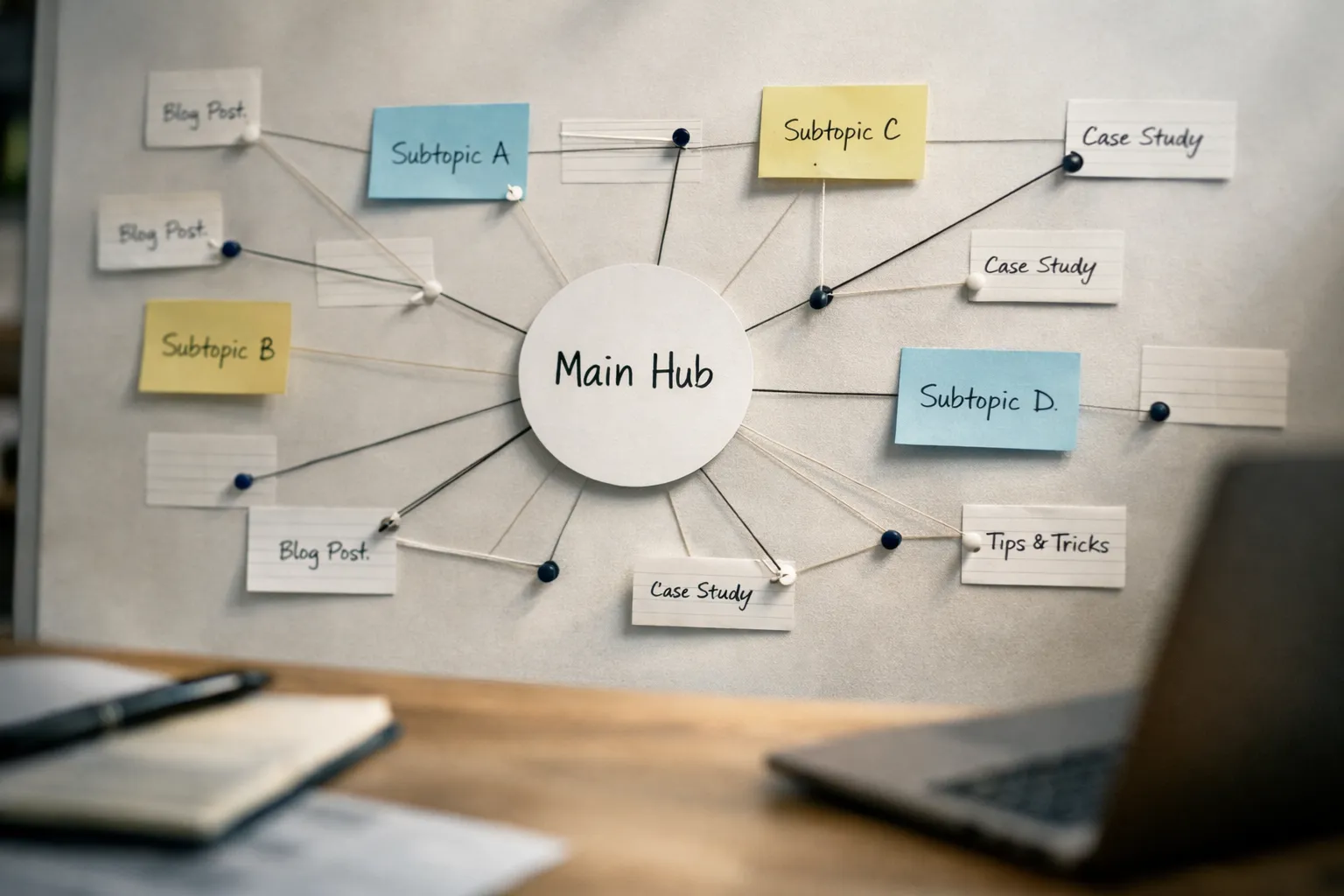
Your hub page should summarize the topic, lay out the sub‑problems, and link out to focused pages that go deep. Those focused pages should link back to the hub and laterally to siblings when it genuinely helps the reader.
A small micro‑story: a 40‑person SaaS team selling billing software rebuilt internal links around five hubs. They reduced orphan pages by 62%, and within four months their non‑brand organic sign‑ups grew by 28%-even though they published fewer net‑new articles. The change wasn’t volume. It was connectivity.
If you want a grounding reference for how search engines interpret structure and signals, Google’s structured data documentation is a good starting point.
Content, structure, freshness: the triad
Content is what you say. Structure is how easily it can be scanned, extracted, and understood. Freshness is whether it still matches reality.
In practice, the triad looks like this: you publish a strong initial page, you make it skimmable with clear sections and consistent terminology, and you commit to revisiting it.
And freshness isn’t “change the date.” It’s updating screenshots, adding new steps, reflecting new constraints, and removing advice that no longer works. In organic search 2026, pages that keep winning tend to be living documents-maintained like a product, not archived like a campaign.
Governance: schemas, sitemaps, and revision cadence
Governance sounds corporate, but it really means reliability. You define what structured data you’ll maintain, how you manage indexation, and how often you revisit important clusters.
A simple cadence that works for many teams: revisit money pages quarterly, supporting posts every six to nine months, and any page with high impressions but falling clicks monthly. This turns SEO into operations.
Why Most AI Content Fails
AI writing tools make it easy to produce words. They don’t automatically produce a useful page.
The gap usually isn’t grammar. It’s thinking. And readers can feel that-even if they can’t name it.
Missing structure and logical scaffolding
A lot of AI content reads like smooth fog. The sentences are fine, but the piece has no scaffolding. The reader can’t tell what to do first, what matters most, or how decisions change based on context.
Strong pages have visible logic: definitions before steps, steps before advanced tips, caveats where needed, and examples that prove the author understands real constraints. Without that structure, you get bounces, low engagement, and no reason for anyone to link to you.
If you’ve ever read a post that “sounds right” but leaves you oddly unsatisfied, you’ve felt this failure mode.
The update problem: decay without maintenance
AI makes publishing easier, which ironically makes decay worse. If you can publish 50 posts a month, you can also create 50 future liabilities.
In 2026 search engine optimization, a page that’s “mostly right” today can become actively misleading in a year. Tools change. UI changes. Policies change. Even definitions shift.
When your content gets outdated, you don’t just lose rankings-you lose trust. And trust is hard to win back.
Editorial control as the differentiator
The teams winning with AI treat it like a drafting assistant, not an author; this is also why a practical AI-assisted writing workflow for SEO matters more than the tool itself. They use tight briefs, strong review, and real expertise in the loop.
Editorial control is also where voice and brand live. Two companies can publish the same topic, but the one that adds firsthand screenshots, real numbers, and specific tradeoffs will feel human.
And humans still buy from humans.
From Publishing Articles to Building Content Engines
Publishing is an activity. A content engine is a system that reliably converts insight into pages that earn traffic, links, and trust.
That difference sounds subtle until you live it. One feels like running on a treadmill. The other feels like building something that starts to help you back.
Pipelines: briefs, drafts, review, publish, refresh
A scalable pipeline usually includes a consistent brief template, a drafting phase, an expert review, a publish checklist, and a refresh backlog.
The refresh step is where most teams fall down, because it feels less exciting than net‑new posts. But refresh work is often where the easiest wins live-especially when a page is already getting impressions.
One approach that holds up in the real world is treating refreshes like product maintenance. You schedule them, track them, and assign ownership. When refreshes are “whenever we have time,” they don’t happen.
Automation with guardrails: templates, components, checks
Automation is helpful when it standardizes the boring parts.
Templates for intros, comparison sections, and FAQ formatting can raise baseline quality. Automated checks for broken links, missing metadata, and thin sections can catch issues before publish.
The guardrails matter, though. If automation starts choosing your topics, your claims, or your conclusions, you’ll drift toward generic content that doesn’t deserve to win-no matter how clean the prose is.
Quality assurance: acceptance criteria and rubrics
QA isn’t just proofreading. It’s deciding what “done” means.
For example, you might decide a page can’t ship unless it includes: a clear problem statement, a practical process, at least one concrete example, and internal links back to its hub. A rubric like that keeps standards consistent across freelancers and in‑house writers-especially as you scale.
How to Build a Sustainable SEO Content System
This is the operational heart of SEO 2026: choose the right topics, publish in a dependency order that builds authority, and monitor the system so it stays healthy.
You’re building an asset, not a pile of documents.
Topic discovery and cluster design
Start with customer reality, not keyword tools.
Talk to support, sales, and success. Sit in on a few demos. Read call transcripts. Look at “why did you choose us?” emails. Then translate those patterns into clusters.
A cluster works best when it maps to a real job: “evaluate analytics tools,” “set up onboarding,” or “reduce churn.” Each cluster should have a hub, several supporting guides, and at least one page that’s highly linkable-like a benchmark, a template, or a calculator.
If you’re wondering where to begin, start where customers already get stuck. Those moments are full of search intent.
Publication logic: cadence, prioritization, and dependencies
Publishing order matters more than most teams think.
If you write ten niche posts without a strong hub, you may never consolidate authority. If you publish a hub with no supporting pages, it can look thin and fail to earn traction.
A practical cadence for small teams is to alternate: one hub expansion or refresh, then one supporting post. Over time, you build depth without losing momentum-or creating a maintenance crisis you can’t pay down.
Updating and monitoring: from alerts to playbooks
Monitoring is how you avoid slow leaks.
Set up alerts for indexation drops, broken templates, sudden CTR changes, and unexpected ranking shifts across a cluster. Then write simple playbooks so you don’t have to guess under pressure.
For example: if impressions rise but clicks fall, you review titles, snippet layout, and SERP features; if rankings drop across a cluster, you audit internal links and freshness; if one template breaks, you prioritize the pages tied to revenue and reputation.
This is where many teams feel actual relief. You stop guessing and start responding.
Example toolchain: crawlers, monitors, and Karwl in context
A typical toolchain includes a crawler for site audits, a rank/visibility tracker, and a content inventory that ties pages to clusters and refresh dates. Many teams use Screaming Frog for crawling, plus monitoring tools that flag changes over time.
If your team wants a workflow that connects audits, internal link opportunities, and refresh planning, a platform like Karwl can sit in the middle as a system of record. The point isn’t the brand. The point is that someone can answer-fast-which cluster is decaying and what to fix next.
For a practical overview that helps align your team on fundamentals, this Ahrefs video is a solid baseline:
GEO, AI Search and the Next Expansion of SEO
The next expansion isn’t replacing classic search. It’s adding new surfaces where answers are synthesized, cited, and sometimes acted on without a click.
This is where GEO and SEO 2026 overlap in practical, day‑to‑day ways: structure, credibility, and “answerability” start pulling more weight.
How AI search consumes and cites content
Generative engines tend to prefer content that’s easy to parse: clear sections, explicit definitions, and unambiguous steps.
They also look for corroboration across sources, which makes brand consistency and factual stability more valuable. If your content is scattered, contradictory, or thin, it’s harder for AI systems to cite or summarize confidently. If it’s structured, it travels.
One underrated skill: writing in “extractable” chunks that still read naturally.
Structured data, entities, and answerability
Structured data isn’t a magic wand, but it is a strong hint. Combined with clear entity coverage, it can improve how your content is understood and reused.
If you want to align with how evaluators think about quality, skim the Search Quality Rater Guidelines. The details are dense, but the spirit is simple: make it clear who wrote it, why it’s trustworthy, and how it helps.
Content patterns that travel across surfaces
Some patterns consistently perform across classic SERPs, AI summaries, and social discovery.
Concise definitions. Step‑by‑step workflows. Decision matrices explained in plain language. Real examples with numbers and constraints.
The pattern isn’t “short content.” It’s “clear content.”

Where Modern SEO Efforts Break: Common Mistakes and System Failures in 2026
Most failures aren’t dramatic. They’re quiet.
A broken internal link here. A neglected hub there. A template update that accidentally noindexes a section of the site. And suddenly the system stops compounding.
In SEO 2026, small operational leaks can outweigh big publishing pushes.
Over-reliance on volume and automation
Publishing faster can help-but only if your quality bar and structure stay consistent.
When automation drives topic choice, teams often drift into the most contested, least differentiated queries. You end up fighting sites with stronger brands, deeper link profiles, or built‑in distribution advantages.
A useful gut check: are you publishing because a tool said “high volume,” or because your customers keep asking the same question in sales calls?
Broken linking, orphaned clusters, and stale hubs
Clusters fail when the hub isn’t maintained or when supporting pages don’t connect back.
Orphan pages can rank briefly, then fade because they aren’t reinforced by internal context. The page exists, but the site doesn’t “vouch” for it.
Process bottlenecks and review debt
Review debt happens when experts are too busy and drafts pile up.
Content ships late, updates don’t happen, and the backlog becomes demoralizing. The work starts to feel like a treadmill: more drafts, fewer wins.
Realistic limits of automation and how to triage
Here are the system failures that show up most often:
- Publishing without a refresh backlog, so the site ages out quietly.
- Treating internal links as an afterthought instead of an architecture.
- Optimizing for a single query while ignoring the cluster that should support it.
- Measuring only rankings, so you miss CTR collapse from SERP changes.
- Letting templates drift, creating inconsistent structure across posts.
If you can fix only one thing this quarter, fix your refresh and linking discipline. It’s unglamorous-and it works.
SEO for Different Company Stages
The right approach changes as you grow.
Early teams need validation and speed. Bigger teams need governance and maintenance. SEO 2026 rewards knowing what stage you’re in and acting accordingly-rather than copying what a very different company is doing.
Early-stage SaaS: validate topics with narrow moats
Early‑stage teams should avoid giant head terms.
Instead, focus on problems your product uniquely solves, integrations you support, and workflows your ICP searches for. The goal isn’t traffic for its own sake. It’s learning and qualified leads.
A good early win is a cluster that supports one sales motion, like “how to automate invoices,” plus pages for common tools your customers use. You’re trying to earn the right visitors, not the most visitors.
Growing teams: build clusters and internal demand loops
Once you have a few people in marketing, you can build real clusters and connect them to product and lifecycle.
For instance: a guide brings the user in, an interactive template helps them succeed, and the product captures sign‑ups. This is where internal linking and consistent UX start to matter as much as content itself.
Established companies: governance, velocity, and refresh SLAs
Established companies often have the opposite problem: plenty of content, inconsistent ownership.
Set refresh SLAs for key clusters, define schema rules, keep templates consistent, and make sure someone has the authority to say, “This page gets updated this month.”
Velocity isn’t just publishing speed. It’s how quickly you can update the truth.
Resourcing: in-house, freelancers, partners
Resourcing gets easier when you separate strategic work from production work.
| Company stage | Best content ownership | What to outsource | What to keep in house |
|---|---|---|---|
| Early | Founder or PM plus a strong writer | Editing, design, occasional specialist review | Positioning, topic selection, examples |
| Growing | SEO lead plus writers | First drafts, graphics, some technical audits | Cluster strategy, internal links, refresh planning |
| Established | Content ops plus SMEs | Production at scale | Governance, measurement, prioritization |
Measuring SEO Success in 2026
If you only track rankings, you’ll miss what’s actually happening.
Mixed results pages and AI answers change the path from impression to click to conversion. In SEO 2026, measurement needs to capture visibility, coverage, and system health.
Visibility vs. coverage vs. system health
Visibility is how often you show up. Coverage is how many meaningful topics and subtopics you own. System health is whether the site is technically sound, well linked, and up to date.
A site can have high visibility in one cluster and still be fragile. Another can have moderate visibility across many clusters and be stable.
The difference is usually operational-not magical.
Leading indicators that predict compounding
Lagging indicators like sign‑ups matter, but you also need leading signals that tell you whether the engine is working.
- Share of impressions across a cluster, not just one keyword.
- CTR by query type, especially when SERP features appear.
- Internal link depth and orphan rate for new pages.
- Refresh completion rate for priority hubs.
These signals help you catch problems early, before traffic drops become obvious.
Attribution in mixed SERPs and AI answers
Attribution gets messy when a user sees an AI summary, later searches your brand, and finally converts through email.
The goal isn’t perfect certainty. It’s directional confidence.
Use assisted conversion views, track non‑brand landing page cohorts, and compare conversion rates by cluster. Over time, you’ll see which topics create demand-not just capture it.
For broader best practices on how search and site experience intersect, Google Search SEO Starter Guide are surprisingly practical.
SEO, Content and Organization
SEO isn’t only a marketing function anymore. It touches product, support, data, and sometimes legal.
When ownership is unclear, good work dies in coordination gaps. You don’t lose because your writing isn’t “good.” You lose because the system can’t ship, maintain, or agree on priorities.
Roles and ownership: who does what, when
A healthy setup usually has one person accountable for the system: the topic model, internal links, and measurement.
Writers own clarity and usefulness. Subject matter experts own accuracy. Engineering or web ops owns templates, performance, and technical hygiene.
If everyone “helps,” no one owns outcomes. And when results wobble, nobody knows what to fix first.
Processes: briefs, reviews, updates, and SLAs
Processes are how you protect quality at speed.
A brief should specify intent, audience sophistication, internal links to include, and what counts as proof (screenshots, numbers, a real example, a sourced claim). Reviews should be time‑boxed, with clear expectations.
Updates need SLAs. Otherwise, refresh work becomes optional-and optional work rarely happens.
Typical failure modes and how to correct them
Common failure modes include endless review loops, publishing without measurement, and relying on one person’s tribal knowledge.
The corrections are often simple: shared templates, checklists, one backlog, and a monthly cluster health review where you decide what gets refreshed next and why.
This isn’t bureaucracy. It’s how you make progress predictable.
How to Think About SEO Long Term
If you treat organic growth like a campaign, you’ll always feel behind.
The long game is building an asset that keeps paying you back. That’s what SEO 2026 rewards most consistently.
SEO as infrastructure, not campaigns
Infrastructure isn’t exciting, but it is dependable.
Your internal link architecture, your content templates, your schema conventions, your refresh cadence-these are the pipes. When the pipes are solid, each new page benefits from the system.
Time horizons: 3, 6, 12, and 24 months
At three months, you’re usually building foundations and shipping the first cluster.
At six months, you can see early winners and adjust. At twelve months, compounding becomes visible if your clusters are connected and maintained.
At twenty‑four months, a strong system can become a moat.
Treat content like a product release: ship, measure, iterate, and maintain.
Budgeting for maintenance vs. expansion
Budgeting is where teams tell the truth.
If you spend everything on expansion, the library decays. A practical rule is to reserve a meaningful slice of effort for refreshes-even when leadership asks for “more new.” Maintenance protects your gains.
FAQ for SEO 2026
These are the questions that come up most when teams try to adjust to a faster, noisier search landscape.
Will AI search make classic SEO obsolete?
No, but it changes where the value shows up.
Classic rankings still matter, especially for transactional and navigational queries. What changes is that you should also optimize for being cited, summarized, and trusted. That pushes you toward clear structure, explicit definitions, and strong entity coverage.
How many articles do we need to see traction in 2026?
There’s no universal number because traction depends on competitiveness, authority, and cluster completeness.
Many SaaS teams see early movement after one strong hub plus six to ten supporting pages, especially if those pages interlink well and match real user intent.
Should we still do keyword research?
Yes-but use it as a lens, not a mandate.
Keyword tools help you discover language, variants, and demand shape. Your strategy should still be built around customer problems, decision points, and the set of entities that define your space.
How often should we refresh content clusters?
Refresh frequency should follow business value and decay risk.
High‑intent pages and hubs deserve quarterly reviews. Supporting posts can often be updated every six to nine months. The key is having an explicit schedule and ownership, not guessing.
What is a sustainable publishing cadence for a small SaaS team?
Sustainable usually means consistent.
For a small team, one high‑quality piece per week is often better than bursts followed by silence. If you can alternate between new supporting posts and refresh work, you’ll build depth without creating a maintenance crisis.
How do we measure brand vs. non-brand impact from SEO?
Separate landing pages and queries into brand and non‑brand buckets, then track both traffic and downstream conversions by cluster.
Also watch the lag: non‑brand content often increases branded search over time. You’re measuring demand creation and demand capture together.
Conclusion: SEO in 2026 Is About Systems, Not Tricks
The teams that win now treat search like a durable capability.
They model topics, build clusters, link deliberately, and keep content fresh. They measure system health, not just rankings, and they accept that SERPs are changing-while still building for users.
Key takeaways and next steps
If your results feel flat, start by auditing your internal linking and refresh backlog. Then pick one cluster where you can be genuinely useful and complete, not just present; for teams trying to operationalize that with AI, a more intent-driven AI SEO system can help. Build the hub, connect the support pages, and set a revision cadence you can actually keep.
In 2026, SEO stops being a race for rankings and becomes an exercise in building systems that stay useful, trustworthy, and visible even as the interfaces around them continue to change.