
If you’ve ever looked at your editorial calendar and thought, “There’s no way we can keep up,” you’re not alone. Teams hit a wall when ideas are coming in faster than drafts, reviews drag on for weeks, and every new request feels like it requires reinventing the wheel.
That’s where a scalable content strategy earns its keep-not by demanding more hustle, but by creating a system that lets you publish more (and better) without burning out your people. And yes, we can keep it human.
Before we get tactical, ask yourself one question: are you trying to create more content, or are you trying to create more outcomes?
What "Scalable" Actually Means (and What It Doesn’t)
A scalable content strategy isn’t “posting every day” or “cranking out 100 articles a month.” It’s the ability to increase output while keeping quality, brand voice, and results steady-or improving them.
Here’s what scalability really looks like in practice:
- Consistency: readers know what to expect from you.
- Repeatability: you can produce content without starting from scratch.
- Resilience: if one writer leaves or priorities shift, the system still works.
And what it doesn’t look like? Chaos in a trench coat. If your process relies on heroics, late nights, and one “content wizard” who knows where everything lives, you don’t have scale-you have risk.
Start With the Audience Job, Not the Channel
A scalable content strategy starts by getting painfully clear on what your audience is trying to do when they come to you. Not what you want to say. Not which channel is trendy. The job.
Think about it this way: people don’t wake up wanting a newsletter. They wake up wanting answers, reassurance, a plan, or a shortcut.
A quick way to sharpen this is to write audience “job statements” like:
- “Help me compare options without feeling stupid.”
- “Tell me what to do first so I don’t waste a week.”
- “Prove this is safe to buy and I won’t regret it.”
Why does this matter? Because once you define the jobs, you can build a repeatable content framework around them. That’s how content strategy at scale stays grounded-even as you add new formats.
Build a Content Inventory You Can Trust
A scalable content strategy can’t run on vibes. You need a clean inventory-otherwise you’ll keep duplicating topics, missing broken assets, and losing institutional memory every time someone changes roles.
If this sounds familiar, here’s the usual pattern:
- A new writer pitches an idea.
- Someone says, “Didn’t we already do that?”
- Nobody can find it.
- You publish it again-slightly worse.
Start simple. Your inventory should include:
- URL
- Title
- Primary topic / intent
- Funnel stage (if that’s how you think)
- Last updated date
- Performance snapshot (traffic, conversions, assisted revenue, etc.)
- Owner (someone accountable)
Here’s a lightweight example you can copy:
| Asset | Primary intent | Last updated | Outcome metric | Action |
|---|---|---|---|---|
| Pricing page | Decision | 2025-09-10 | Demo requests | Refresh proof points |
| “How to choose X” blog | Comparison | 2024-12-02 | Assisted conversions | Update + add new examples |
| Case study: Retail | Validation | 2025-01-18 | Close rate influence | Repurpose into slide deck |
This is unglamorous work. It’s also the foundation of data-driven content scaling.
Choose a Repeatable Content Model
A scalable content strategy gets dramatically easier when you stop treating every piece like a bespoke magazine feature. You don’t need cookie-cutter writing-you need predictable structures.
Two models tend to work across industries because they’re flexible and easy to operationalize.
The "hub-and-spoke" pattern
Create one authoritative hub (the “pillar”) and a set of supporting pieces (the “spokes”). The hub stays stable; the spokes expand as you learn.
Example: A cybersecurity company publishes a hub on “Zero Trust Basics,” then spokes like “Zero Trust for SMBs,” “Implementation checklist,” and “Common mistakes.” Same theme, different intent.
The "template-first" pattern
This is the backbone of programmatic content strategy when done responsibly.
Instead of writing 200 pages from scratch, you define a high-quality template:
- a consistent intro that sets context
- a standard evaluation framework
- examples pulled from a vetted dataset
- a clear “next step” section
Then your team fills the template with research, expertise, and specifics. The template keeps quality steady; the human input keeps it useful.
Design Your Workflow Like a Production Line (Without Killing Creativity)
A scalable content strategy lives or dies in workflow. Not in brainstorming. Not in a fancy tool. In the boring middle: assignments, drafts, reviews, approvals, and updates.
Here’s a simple way to remove friction without turning writers into robots:
- Define “definition of done” for each stage (drafted, edited, legal-approved, published).
- Limit work in progress (WIP). Too many open drafts = nothing ships.
- Use checklists for repeatable steps (SEO basics, accessibility, formatting, internal links).
Micro-story: one enterprise team I worked with reduced review time by nearly half just by adding two things-(1) a single owner per piece, and (2) a standard “review brief” that told stakeholders what feedback was needed (and what wasn’t). Suddenly, comments went from “I don’t like this” to “We need a more accurate definition in paragraph two.” That’s scaling content operations in the real world.
Use Data to Decide What to Publish Next
A scalable content strategy doesn’t mean you publish more. It means you publish what’s most likely to work.
So what data should guide you?
- Search demand and intent (what people are actually trying to do)
- Sales questions (what prospects ask repeatedly)
- Support tickets (where users get stuck)
- On-site behavior (what content leads to product exploration)
And here’s the uncomfortable question: if a topic has “good volume” but doesn’t help your buyer, should you chase it anyway?
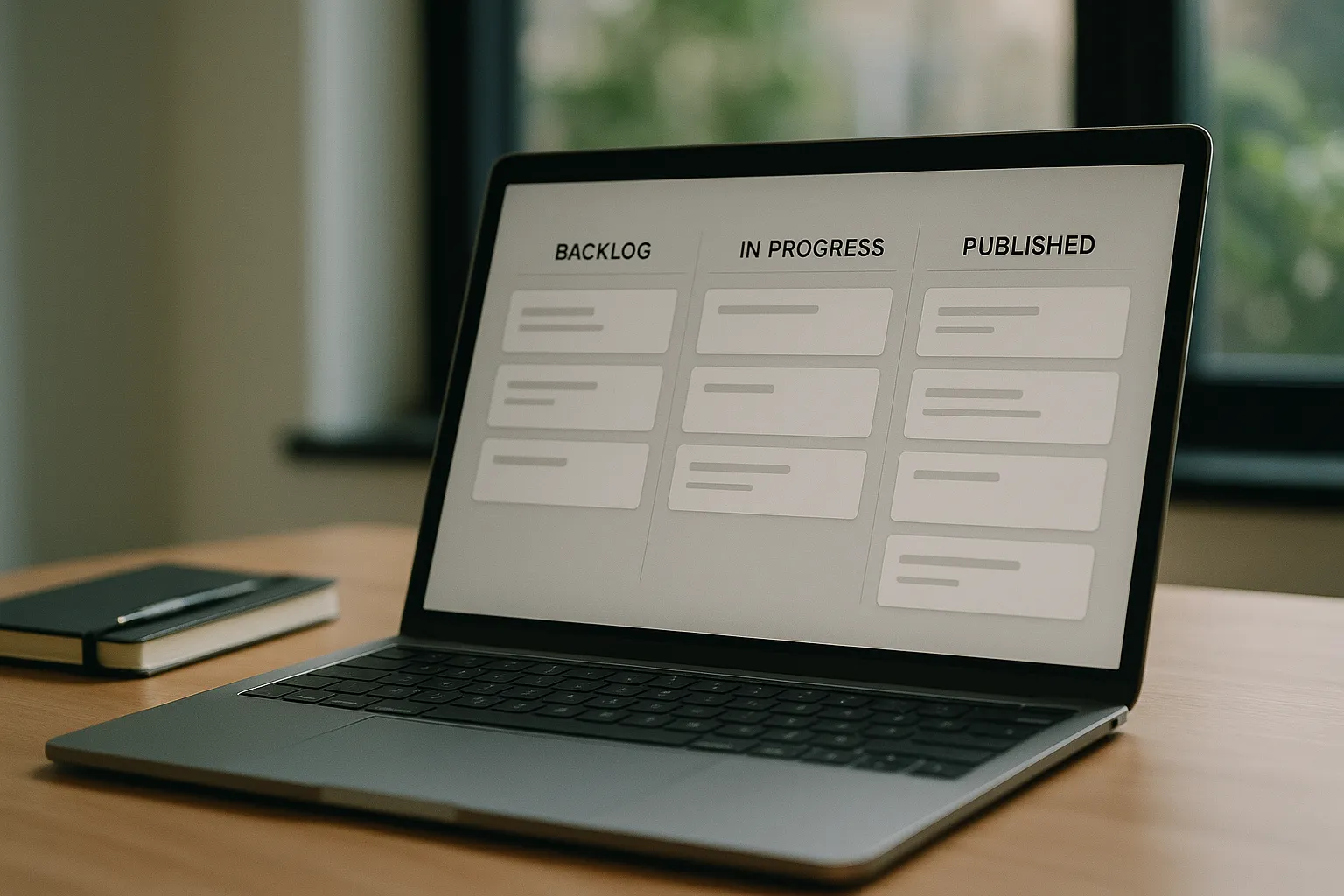
A practical approach is to maintain a single prioritized backlog-like a product team would. That backlog becomes your high-velocity content plan, and it prevents random acts of content.
Where AI Helps-and Where It Hurts
A scalable content strategy can absolutely be supported by an AI-first content strategy-but only if you’re honest about what AI is good at.
AI helps when you need:
- outlines that speed up first drafts
- content variations for different audiences
- summarizing long sources
- extracting entities, FAQs, and structured nuggets
AI hurts when you use it to:
- replace subject-matter expertise
- publish generic advice with no point of view
- skip fact-checking
- mimic competitors until your voice disappears
A simple rule we use: AI can accelerate the “blank page” problem, but humans own accuracy and judgment.
“Scale doesn’t come from writing faster. It comes from deciding faster-and editing with purpose.”
That’s how automation-led content strategy stays credible.
Governance: Guardrails That Keep Teams Moving Fast
A scalable content strategy needs governance, especially as you grow into an enterprise content strategy with more stakeholders.
Governance sounds stiff, but it’s basically answering:
- Who can publish?
- Who can change core messaging?
- What requires legal review?
- What counts as “on brand”?
The goal isn’t control. It’s speed.
When guardrails are clear, teams stop re-litigating the same debates. You’ll see fewer last-minute rewrites and fewer “Can you just tweak the tone?” comments that arrive 24 hours before launch.
Measure the Right Things (and Ignore Vanity Metrics)
A scalable content strategy should be measured like a system, not like a popularity contest.
Yes, track traffic. But don’t stop there.
Consider building a scorecard with a few metrics per stage:
- Reach: organic visits, impressions
- Engagement: scroll depth, time on page, return visits
- Action: demo requests, sign-ups, trials, qualified leads
- Efficiency: cycle time (idea → publish), cost per asset, update cadence
Here’s a question worth asking in every monthly review: are we getting faster and getting better, or just getting louder?
This is where content ops at scale becomes visible. You can’t improve what you don’t instrument.
A 90-Day Rollout Plan You Can Actually Follow
A scalable content strategy doesn’t have to be a massive overhaul. In fact, smaller moves compound faster.
Try this 90-day sequence:
Days 1-30: Stabilize
- Inventory your top assets (start with the 20% that drives 80% of results)
- Define 3-5 audience jobs
- Set workflow stages and a definition of done
Days 31-60: Standardize
- Pick 2-3 repeatable formats (comparison page, glossary, playbook, case study)
- Create templates and checklists
- Establish governance: approvals, voice rules, update ownership
Days 61-90: Scale responsibly
- Build a prioritized backlog tied to outcomes
- Introduce AI for specific steps (outlines, summaries, repurposing) with a workflow you can trust (see AI blog automation pipeline)
- Set a refresh cadence and measure cycle time
If you only do one thing this quarter, do this: choose a repeatable content framework and commit to shipping it consistently. The momentum you’ll feel is real-and it’s the kind that doesn’t require panic.