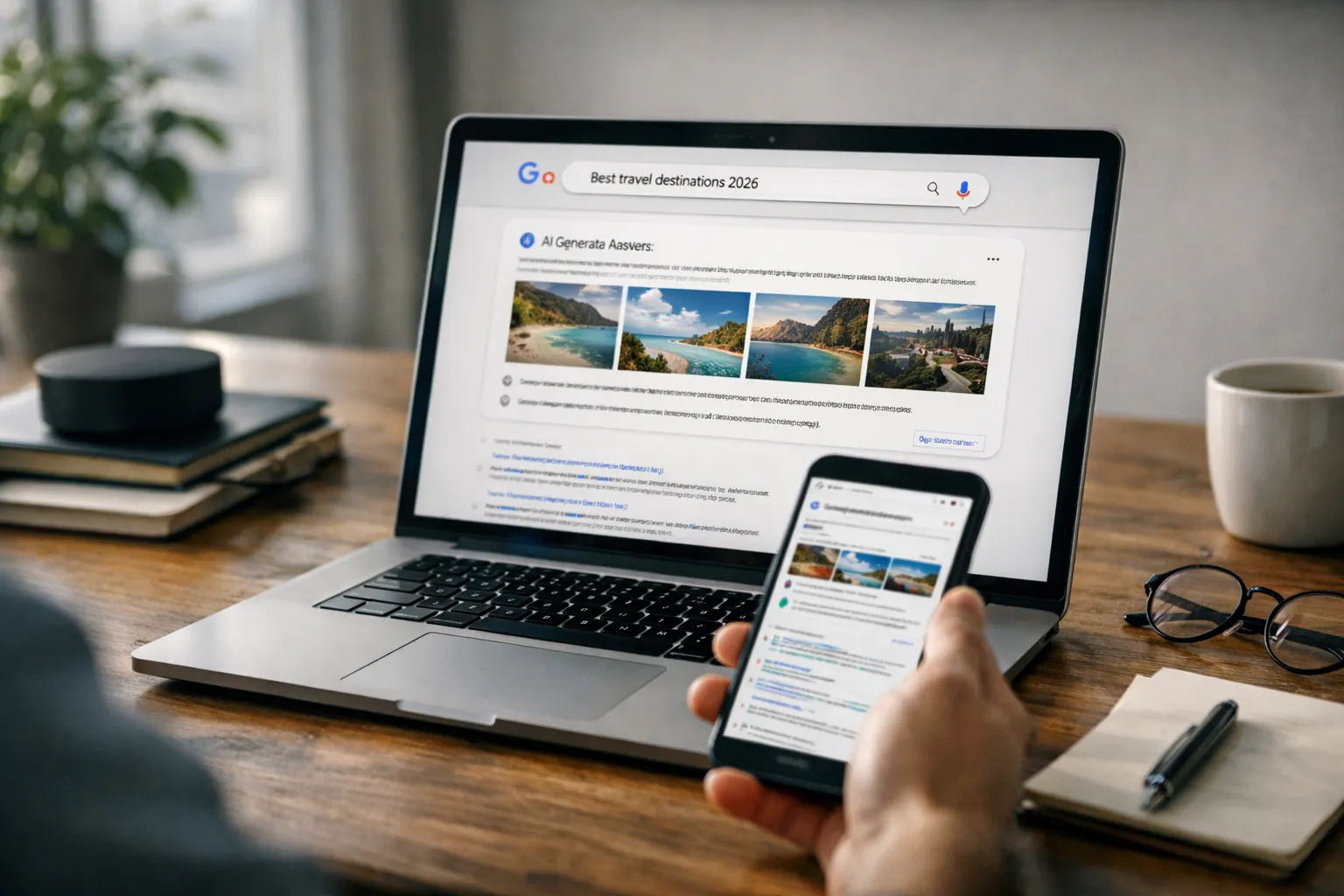
If you’ve been doing SEO for a while, you can feel the ground shifting. People still search, sure-but now they also get answers. Sometimes they never even make it to your site. That’s why AI search results SEO has become less about chasing a blue link and more about becoming the source the answer is built on.
So what do we do with that? Panic? Rewrite everything? Throw money at tools?
Or… do we get practical, adjust the way we publish, and give AI systems the kind of information they’re comfortable quoting?
Why AI changes what “ranking” means
In classic search, visibility often meant: rank high, win the click, convert on-page. In AI-driven experiences, visibility can look like a mention, a citation, or a short excerpt that answers the question without a click.
That’s not automatically bad. Being cited in an AI overview can be like being quoted in a high-profile article: it builds trust fast. But it also means your content has to work in smaller, sharper pieces.
Here’s the emotional reality, though: it’s uncomfortable to watch impressions go up while sessions stay flat. You’re not alone if that feels like you’re doing work and someone else is getting the credit.
The shift with AI search results SEO is that you’re optimizing for two audiences at once: humans who want clarity and AI systems that need structure, corroboration, and confidence.
How AI chooses sources (and how you can influence it)
AI systems don’t pick sources at random. They’re trying to reduce risk: risk of being wrong, risk of being inconsistent, risk of being unhelpful.
So they look for patterns that say, “This is a safe page to borrow from.” Not “safe” as in boring-safe as in credible.
Signals that still matter
Plenty of traditional signals are still in play:
- Strong internal linking that helps the crawler understand your topic map
- Clean indexation (no accidental noindex tags, canonical issues, or duplicate clutter)
- Pages that satisfy intent (not just match keywords)
But those are table stakes now. You can’t “technical SEO” your way into being a great source.
Signals that matter more now
What’s become more important is source quality. Think: citations, data provenance, clear authorship, and content that’s easy to quote without rewriting.
A quick micro-story: I once worked with a B2B company whose blog posts were full of good ideas-but every key claim was framed like marketing copy. We rewrote two articles to include a simple definition, one real example, and a link to an external standard. Within weeks, those pages started getting picked up in summaries and “people also ask” style answers. Nothing magical changed. We just made the content easier to trust.
In AI search results SEO, “trust” often looks like:
- Precise statements (dates, ranges, constraints)
- Clear definitions near the top of a section
- Named sources when you reference research (even if it’s your own)
And here’s a question worth asking as you edit: if someone copied one paragraph from your page into an answer box, would it still be accurate and complete?
Content formats that show up in answers
AI summaries love content that is:
- Structured (headings that match real questions)
- Specific (examples, numbers, boundaries)
- Modular (sections that stand alone)
That doesn’t mean you have to write like a robot. It means you write like a helpful specialist who anticipates the follow-up question.
A good pattern is: define → explain → illustrate → qualify.
For example, instead of “Our platform improves reporting,” try something like: define what “reporting” means in your context, explain how it changes, show a before/after scenario, and add the caveat (what it doesn’t do, or when it won’t help). Those qualifiers are surprisingly persuasive-because they sound honest.
A newsroom editor I worked with used to say: If a claim can’t survive a copy-paste, it doesn’t deserve to be published.
If you’re building a content team workflow, that’s a useful litmus test for AI search results SEO: can your best paragraphs stand alone as quotable, accurate snippets? If you’re leaning on AI to draft, it also helps to know why most AI content fails SEO and how to fix it.
Technical basics you can’t ignore
Let’s get this out of the way: you don’t need a brand-new site to compete. But you do need a site that doesn’t confuse machines.
Focus on:
- Schema where it truly fits. Organization, Article, Product, FAQ (only if it’s genuine FAQ), HowTo (only if it’s actually step-based). Don’t add markup “because SEO.” Add it because it clarifies.
- Fast, stable pages. Not for a score-because slow pages often correlate with bloated templates, messy scripts, and fragile rendering.
- Consistent canonical and indexation rules. AI systems can’t cite what they can’t reliably retrieve.
In AI search results SEO, technical work is less about gaming the algorithm and more about removing friction. Think of it like cleaning your kitchen before you cook: it doesn’t make you a better chef, but it stops you from getting in your own way.
Measuring success when clicks drop
If you only measure sessions, AI-driven search can feel like a loss even when you’re gaining visibility.
So broaden your scoreboard. Ask: are we becoming the source?
Here’s a simple way to reframe reporting:
| What you measured before | What to add now | Why it matters |
|---|---|---|
| Rankings for head terms | Citations/mentions in AI overviews (manual checks + SERP tracking where possible) | Shows whether you’re being used to answer questions |
| Organic sessions | Branded search lift and direct traffic trends | Good citations often increase brand recall |
| Pageviews per post | Assisted conversions and sales-cycle influence | Many journeys start with an answer, not a click |
| CTR from SERPs | Impression growth + query coverage | You may “win” visibility without winning the click |
One more question to keep you honest: if AI summarized your page today, would it reflect your brand accurately-or would it turn your nuance into something generic?
AI search results SEO is partly about protecting meaning, not just chasing exposure.
A practical 30-day plan
If you want momentum without boiling the ocean, run a one-month sprint. The goal isn’t to publish more. It’s to publish more quotable, more defensible content.
- Week 1: Source audit. Pick 10 pages that already earn impressions. Rewrite openings to include a clear definition and a one-sentence “best answer” summary. Add one external reference where appropriate.
- Week 2: Intent cleanup. For each page, identify the primary question it answers. Then remove or move anything that distracts from that question. Add a short “When this doesn’t apply” section to reduce overclaiming.
- Week 3: Entity and credibility pass. Add author bios where it makes sense, cite original research, and link to primary sources. Tighten internal links so each page sits clearly in a topic cluster.
- Week 4: Snippet readiness. Make key sections stand alone: short headings, crisp definitions, examples with constraints. Test by reading a section out of context-does it still make sense?
This approach fits AI search results SEO because it prioritizes retrieval-friendly clarity, not content volume. If you want to speed up briefs and refreshes without creating thin pages, see AI SEO tools that work for real teams.
Final thoughts
The big unlock here isn’t a trick. It’s a mindset shift: you’re not only competing for clicks-you’re competing to be the reference.
When you treat your content like something that could be quoted, audited, and reused, you naturally write with more care. And that’s what AI systems tend to reward.
If you take one thing from this: make your best pages easier to cite than your competitors’. That’s the heart of AI search results SEO, and it’s a strategy you can start executing today. If you need a repeatable workflow to produce those pages, make AI-assisted writing rank faster in 2025.