You can feel it in every SEO standup meeting lately: the workload hasn’t just grown - it’s multiplied.
Search results change faster. Competitors publish more. And the expectations haven’t gotten any kinder. If you’re trying to keep quality high while shipping content weekly (or daily), you’re probably looking at AI SEO tools 2025 as less of a shiny trend and more of a lifeline.
But here’s the catch: not all AI helps. Some features save you hours. Others quietly create new problems - thin pages, generic copy, or keyword maps that look great in a spreadsheet and fail in real search.
So let’s talk like humans about what actually works, what to watch for, and how to build a workflow you’d trust with your brand.
What’s Different About SEO in 2025
SEO hasn’t become “easier.” It’s become more layered.
- Search intent shifts faster than most editorial calendars can keep up.
- SERPs are more crowded, with answers, snippets, product modules, forums, and video blocks.
- Content quality is judged more holistically-not just by keywords, but by usefulness, originality, structure, and credibility.
If you’ve ever refreshed a SERP and thought, Wait, when did all these Reddit threads show up? - you’re not imagining things.
That’s why many teams are leaning into ai-powered seo platforms to handle the heavy lifting: pattern recognition, entity coverage, clustering, and fast iteration. The goal isn’t to replace strategy. It’s to clear the runway so you can actually do strategy.
How to Choose the Right Tools Without Getting Overwhelmed
The tool landscape is noisy. Every demo looks slick. Every feature list sounds essential. So here’s a practical filter: start with your bottleneck.
Ask yourself:
- Are you stuck at topic selection (what to publish next)?
- Are briefs inconsistent and hard to delegate?
- Do writers struggle with structure, on-page basics, or matching intent?
- Are you blind to what changed after an update?
Two teams can buy the same ai seo software and get wildly different results because their workflows are different.
A quick micro-story: one B2B SaaS team I worked with had solid writers but terrible alignment. Posts were well-written, yet missed the “jobs to be done” that customers actually searched. Their fix wasn’t “more content.” It was better briefs-and a lightweight review process where AI surfaced gaps, while a human decided what mattered.
And yes, this is where AI SEO tools 2025 can shine: not as a replacement for taste, but as a consistency engine.
Where AI Helps Most (and Where It Doesn’t)
Let’s be honest: AI is brilliant at some tasks and mediocre at others.
High-impact use cases
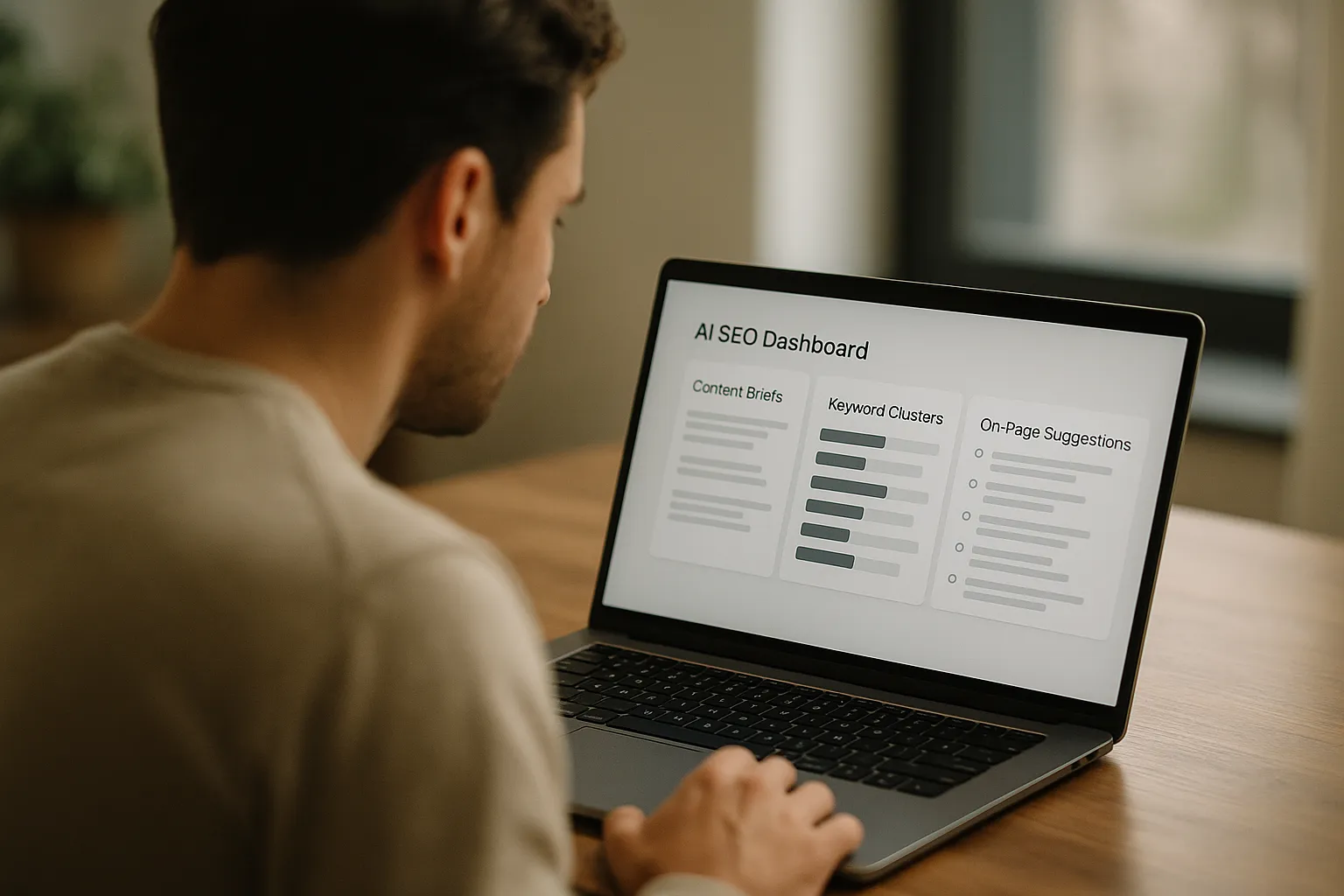
- Keyword clustering and intent labeling: ai keyword research tools can group thousands of terms and spot patterns faster than any human.
- Content briefs and outlines: ai content brief generators can standardize structure so writers don’t start from a blank page.
- On-page checks: ai on-page optimization software can flag missing elements (headings, entities, internal links, schema opportunities).
- Content refresh recommendations: machine learning seo tools can detect decaying pages and suggest what to update based on current SERP patterns.
Where you still need a human
- Brand voice and point of view: AI can imitate tone, but it won’t own an opinion.
- Original examples and reporting: real screenshots, customer stories, and firsthand testing still win.
- Editorial judgment: should you target a term, avoid it, split content, consolidate pages? That’s strategy.
If you’re wondering, Can’t AI just write the whole article? -it can write something. The question is: will it sound like you, match intent, and earn trust?
A useful rule: let AI draft the “what” and “how,” but keep the “why” and “so what” in human hands.
A Simple Evaluation Checklist You Can Use Today
Before you commit to an ai-driven seo solution, run it through a real workflow test. Not a demo. Not a sales call. A real task you actually do every week.
Here’s a checklist that keeps things grounded:
- Does it explain recommendations? If it can’t show its reasoning, you can’t trust it.
- Can you customize outputs? Templates, tone, brief sections, intent rules, and scoring should be adjustable.
- Does it work with your stack? CMS, Google Search Console, analytics, rank tracking, content ops.
- How does it handle updates? Can it detect shifts and suggest specific fixes?
- Does it protect you from generic content? Look for features that push originality: unique angles, evidence prompts, expert quote fields.
One more question worth asking: Will this tool make my team faster-or just busier?
A Practical Comparison Table (What to Look For)
Below is a quick way to map common needs to typical capabilities. Think of it as a shopping list you’ll tailor to your situation.
| SEO need | Helpful AI capability | What to verify in a trial | Common pitfall |
|---|---|---|---|
| Topic planning | Clustering + intent detection | Clusters make sense to humans | Clusters that mix different intents |
| Content briefs | SERP-based outline + entity coverage | Brief is clear enough to delegate | Overstuffed briefs that kill readability |
| Draft support | ai writing tools for seo with guardrails | Can it keep your voice and structure? | Generic phrasing and repeated sections |
| On-page optimization | Suggestions for headings, links, schema | Recommendations align with intent | Chasing scores instead of usefulness |
| Refreshes | Decay detection + change recommendations | Can it cite what changed in SERPs? | Blindly rewriting what already works |
How to Build a Workflow That Feels Human (Not Automated)
If you’ve tried seo ai tools and felt underwhelmed, it might not be the tool. It might be the workflow.
Here’s a model that tends to work well in real teams:
1) Start with an intent-first brief
Use AI to gather SERP patterns, common subtopics, and questions. Then add one human-only section:
- What do we believe that others aren’t saying?
- What examples can we provide that are real?
- What’s the one thing a reader should do next?
2) Draft fast, then edit like you’re protecting a reputation
AI can speed up the first 60%. Your job is the last 40%: clarity, structure, proof, specificity.
A practical trick: when you edit, replace vague lines with concrete ones. Instead of “optimize your content,” say “add a comparison section, link to your pricing page, and include a short decision checklist.”
3) Measure outcomes that matter
Rankings are useful, but they’re not the only scoreboard. Track:
- clicks and CTR by query type
- conversions or assisted conversions
- internal link lift to priority pages
- refresh impact on older posts
This is where AI SEO tools 2025 earn their keep: not by producing more words, but by making your improvements targeted.
Common Mistakes Teams Make (So You Can Skip the Pain)
Even strong teams stumble in the same places:
- Letting the score drive the page: optimization scores are hints, not commandments.
- Publishing too many near-duplicate articles: AI makes it easy to create content; it also makes it easy to cannibalize yourself.
- Forgetting the reader: if a page feels like it was written to impress an algorithm, readers leave.
If you take one thing from this article, take this: treat AI like a sharp assistant, not an autopilot.
What Success Looks Like Going Forward
When AI is used well, it doesn’t feel like a shortcut. It feels like your team suddenly has breathing room.
You ship briefs faster. Writers start with stronger structure. Updates get handled before traffic drops for months. And your content sounds like it came from a real organization with real experience.
That’s the promise of AI SEO tools 2025 - not magical outcomes, but steadier execution.
If you’re building your stack this year, choose one or two tools that match your biggest bottleneck, run a real pilot, and document what changes. Do that, and you’ll be ahead of most teams who are still collecting subscriptions and hoping something clicks.
And if you’re still on the fence, ask yourself one last question: What would you do differently if you had three extra hours every week? That’s the real ROI target-and the right ai seo suites can help you get there.