
What if your next blog post didn’t take a week of calendar Tetris and late-night edits? Imagine drafting it in an afternoon, weaving in your team’s real-world know-how, and still meeting modern search standards. That’s the appeal of AI-speed without losing the human heartbeat. But here’s the catch: speed without strategy leaves you with a content graveyard. The sites winning search this year aren’t cranking out copy; they’re running repeatable, human-guided systems that get better every month.
In this guide, we’ll walk through AI content writing for SEO as a practical, end-to-end workflow-from keyword research and outline design to drafting, humanizing, publishing, and monitoring. We’ll use a real tool, Karwl, to make the process concrete and point to Google’s own guidance along the way. The goal: turn AI from a fun toy into a reliable team member.
How to write SEO blog posts with AI: what matters for rankings in 2025
Modern search isn’t about sprinkling a keyword in every paragraph. It’s about showing you understand the problem behind the query. In 2025, that means aligning AI outputs to search intent, topical depth, and credible on-page signals. Use AI to accelerate thinking, not to replace it. Think of AI as your high-speed co-pilot; your editorial judgment stays in the pilot’s seat.
Why AI content writing for SEO works now
Generative models are finally excellent at spotting patterns across thousands of SERP results. They surface common subtopics, rank-worthy formats (checklist, tutorial, comparison), and gaps your competitors left wide open. Hours of research collapse into minutes, freeing you to focus on what search actually rewards: original insight, real experience, and specific, helpful detail.
Practically, the model suggests the shape of the piece; you inject lived experience, unique data, and brand voice. Done right, you’ll speed up iteration, raise baseline quality, and measure what moves the needle. Here’s the crisp takeaway: AI lowers the cost of exploration, so you can afford to be more creative. More speed means more tests, and more tests lead to more wins.
A quick example: a niche cybersecurity blog used AI to map SERP patterns for “threat modeling frameworks.” They spotted a missing angle-hands-on worksheets-then added a downloadable checklist based on their consultants’ internal docs. Result? The post became their top entry point for demo requests within a quarter.
Early pitfalls to avoid when adopting AI for content
The most common mistake? Shipping untouched drafts. Even small additions-screenshots, firsthand examples, a short customer quote-signal real-world experience that readers and algorithms notice. Another trap is ignoring intent. If searchers want a beginner’s checklist, don’t force a hard sell. Use AI to map what people expect at each stage of the journey and deliver that.
One more tip: track what you change. Keep a simple log of prompts, edits, and publishing tweaks so you can connect performance to process. AI without a feedback loop turns into noise. Adopt a mantra: prompt, draft, test, refine, repeat. It’s boring in the best way.
AI keyword research to blog outline workflow (with Karwl)
Before you draft, you need a clear map. Keyword research with clustering gives you the territory; the outline gives you the route. In Karwl, you can move from keywords to an editorial brief in minutes without losing sight of search intent or reader needs.
Here’s a compact view of how clusters translate into outlines.
| Keyword Cluster | Primary Intent | Reader-First Angle | Core Sections |
|---|---|---|---|
| "best time tracking tools" | Commercial investigation | Role-based picks (freelancer, agency, enterprise) | Criteria, Top Picks by Role, Setup Tips, FAQs |
| "how to create sops" | Informational | Templates + pitfalls from ops leaders | What is an SOP, Step-by-Step, Templates, Common Mistakes |
| "crm vs spreadsheet" | Comparative | Cost-risk analysis by team size | Pros/Cons, Costs, Migration Steps, Case Study |
Pick primary and secondary keywords in Karwl to match search intent
Start with a seed term and generate clusters. Choose one primary keyword per article and 3–6 secondaries that naturally align with subheadings. Label each cluster with an intent (informational, navigational, commercial investigation, transactional). That clarity sets the tone, format, and CTAs. If the SERP shows starter guides and checklists, don’t fight it-lean into the format, then add your edge.
A micro-story: a fintech blog chose a commercial-investigation cluster but kept the tone educational. By adding pricing tables, switching calculators, and migration steps, their article captured late-funnel traffic they’d been missing. The lesson? It’s not just the keyword-it’s the mindset of the searcher.
Turn keyword clusters into a reader-first outline and angle
Map each secondary keyword to a clear subtopic. Then pick an angle-a throughline that makes the piece memorable. For a “tools” query, your angle might be “best-for” by persona. For a “how to,” it might be “mistakes to avoid from real projects.” Angles prevent generic writing and make your advice stick.
Add constraints to your brief: a target word count, must-include examples, and one core takeaway you want readers to remember. Constraints don’t limit creativity; they channel it.
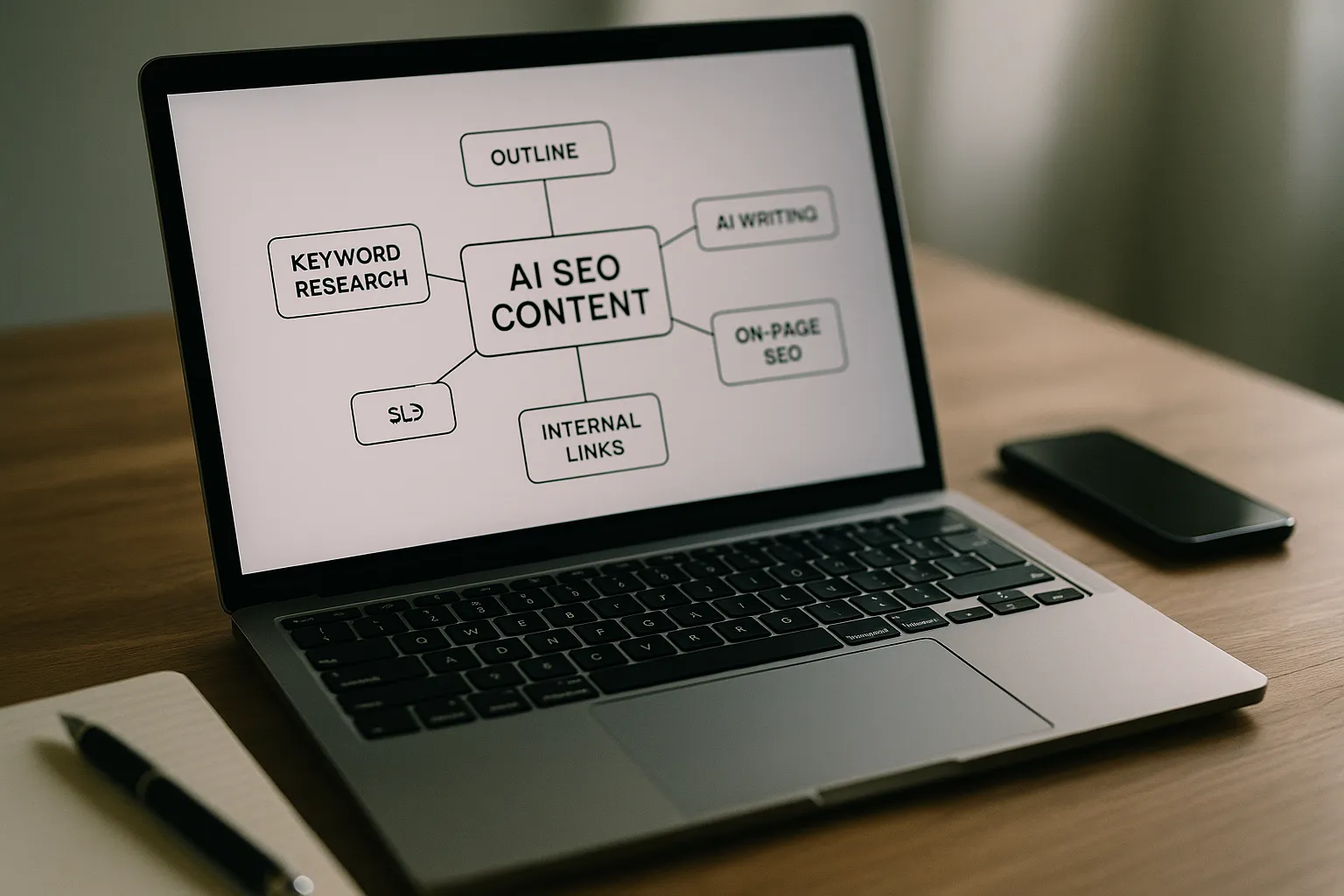
AI blog post drafting and on-page optimization
Drafting is where ideas meet the page. Use AI for a SERP-aware first pass, then refine for clarity, depth, and brand voice. Think of that first draft as scaffolding-useful for structure, removed or reshaped as you finish the build.
SERP-aware drafting: prompts, briefs, and competitive gaps
Feed the model your brief: primary and secondary keywords, intent, angle, and required sections. Include a mini-SERP summary (top 3–5 results and their differentiators). Ask the model to propose an outline and call out what competitors missed-original data, screenshots, calculators, or experience-based shortcuts.
Case in point: a B2B SaaS team adopted this approach and shipped two posts per week instead of one, cutting drafting time by 40%. In eight weeks, two posts that directly filled SERP gaps drove a 28% lift in organic clicks versus similar topics from the previous quarter. Not magic-just focus and faster iteration.

On-page elements to optimize with AI (titles, headers, schema, links)
Use AI to generate options, then trust your judgment. Here’s a tight checklist to keep quality high and time low:
- Title variants that match the angle and intent; one power word is plenty.
- Meta description drafts that promise a clear outcome in active voice.
- Header mapping so each secondary keyword lands where it belongs.
- Internal link suggestions to cornerstone content; prune anything off-topic.
- Schema starters (Article, FAQ) you’ll validate against Google’s guidelines.
Validate structured data with Google’s structured data guidelines. Little things compound-clean titles, crisp intros, and logical headers improve engagement signals search engines notice.
Humanize AI-generated content for SEO
If your draft reads like a toaster manual, it’s not ready. Humanizing means adding lived experience, real stakes, and credible signals. The aim: move from “accurate but bland” to “useful and memorable.” Ask yourself: would a smart, skeptical reader save this or share it?
Add E-E-A-T signals: experience, sources, and author credibility
Show proof. Add screenshots of your workflow, short anecdotes with outcomes, a customer quote (with permission), and links to authoritative references. Attribute stats. Include an author bio that makes it obvious why this person can be trusted.
Quick test: If a reader asked, “Have you actually done this?” your article should make them nod before they finish the first scroll.
Externally, cite standards like Google Search Central to align with people-first guidance. Internally, reference your own research, product data, or experiments where relevant. Credibility scales when you systematize it: a source checklist, a brief author Q&A before publication, and a consistent byline format.
A short story: an ops lead at a logistics startup added two screenshots of their SOP template in action plus a 90-day outcome (30% fewer errors). The post didn’t just rank-it closed deals because it felt real.
Rewrite frameworks to de-robotize tone without losing clarity
Use simple rewrite frameworks:
- Explain it to a busy manager: short sentences, outcomes first.
- Show, then tell: example before concept.
- Contrast: what most people do vs. what works better.
Ask AI for three analogy ideas; pick the one your audience would actually use in conversation. Trim filler. Swap generic verbs for precise ones. Front-load value in every section. The human touch isn’t decoration-it’s differentiation.
Publish AI content safely for search and operationalize it in Karwl
Publishing is where editorial meets governance. Treat it like a product release: QA, ship, monitor, iterate. Karwl can anchor this with a workflow that takes you from brief to draft to performance review without losing context.
Set up a repeatable Karwl workflow: briefs → drafts → QA → publish → monitor
A simple, consistent pipeline prevents chaos and makes improvement measurable.
- Create brief templates with intent, angle, sources, and must-include examples.
- Generate and refine drafts against the brief; log what you changed and why.
- QA for E-E-A-T: author bio, citations, screenshots, and schema.
- Publish with tracked internal links and transparent update notes.
- Monitor in Search Console; schedule 30/60/90-day refresh checks.
Pair this with a decision log: which headlines you tested, which internal links you added, and why sections were rewritten. Patterns will emerge. When you find a winning play-say, adding FAQs boosts long-tail impressions-bake it into the template so it scales.
Conclusion and next steps
AI won’t replace editors. Editors who use AI well will outpace those who don’t. Start small: pick one cluster, build a brief in Karwl, draft with a SERP-aware prompt, then humanize it with real experience. Publish, measure, iterate. One strong process beats a hundred one-offs.
If you need a north star, keep this close: useful beats novel, clarity beats clever, and consistency beats sprints. Ready to try one post this week and see what you learn?
FAQ for AI content writing for SEO
Will Google penalize AI-generated content if it’s disclosed?
Google evaluates content on helpfulness, quality, and experience-not the tool that produced it. Disclosure can build trust with readers, but it isn’t a ranking factor on its own. Focus on intent alignment, depth, and credible sourcing. When in doubt, follow Google’s people-first guidance and let your editing standards carry the weight.
How do I choose between multiple keyword clusters for one post?
Pick one cluster as your spine-the one with the clearest intent and strongest traffic potential for your site’s authority. If two clusters share intent and structure, merge the secondaries; otherwise, create separate posts and cross-link. Golden rule: one primary promise per page.
What’s a safe AI-to-human editing ratio for quality and efficiency?
A common split for long-form: 60/40. AI handles structure and first-pass copy; humans add experience, examples, screenshots, and tone. For complex or YMYL topics, shift toward 40/60. The higher the risk and nuance, the more human time you invest.
How do I measure success after publishing AI-assisted content?
Track a core dashboard: impressions and clicks by query group, average position for the primary cluster, scroll depth, time on page, and assisted conversions. Compare to a baseline window and tag any updates. If engagement rises but clicks stall, refine titles and meta. If clicks rise but conversions lag, tighten internal links and CTAs.
Which parts of the workflow should remain fully human?
Topic selection, angle setting, and final judgment on claims. Humans should approve sources, add lived experience, and own the voice. Use AI for speed-research synthesis, outline drafts, on-page suggestions-but let humans guard accuracy, empathy, and brand. That blend wins readers and algorithms alike.