
A few years ago, SEO felt like driving with paper maps. You could get there, but every detour cost time. Today, it feels more like having a co pilot who can read the road ahead, call out hazards, and suggest faster routes. That is what ai for seo can be when you use it wisely: not a magic wand, but a decision assistant that helps you spot opportunities, move faster, and stay consistent.
Still, there is a catch. Search visibility is not a single problem. It is a chain of small problems: picking the right topics, matching intent, structuring pages, fixing technical friction, and earning clicks once you show up. AI can support each link in that chain, but only if you treat it like a workflow tool, not a content vending machine.
In this guide, you will see seven practical workflows you can plug into your weekly routine. They cover keyword research, SERP pattern analysis, on page optimization, content refresh loops, internal linking, topical architecture, and CTR testing. Along the way, you will also see how to keep quality high, avoid sloppy automation, and measure the impact like a grown up.
AI for SEO: How AI and SEO Work Together for Higher Organic Visibility
AI and SEO fit together because both are pattern games. SEO is about understanding what people search for, what search engines can interpret, and what makes a result worth clicking. Machine learning excels at surfacing patterns across messy data, like query variations, page templates, and user behavior signals.
The simplest way to think about it is this: traditional SEO tells you what to do, and AI helps you do it faster and with more consistency. For example, AI in SEO can summarize the intent behind a keyword set, draft multiple title options that align with that intent, and flag pages that look thin compared to top results. But humans still have to decide what is true, what is useful, and what matches the brand.
A healthy model is “human sets direction, AI accelerates execution.” You define the goals and guardrails, then use AI to reduce grunt work: clustering, outlining, rewriting for clarity, turning logs into action lists, and generating hypotheses to test. If you want a reliable north star, anchor your decisions to Google’s own guidance on creating helpful content from Google Search Central.
One punchy rule that saves time: if a task requires judgment, use AI to propose options. If a task requires precision, use AI to validate and check.
Workflows 1-2: AI-Enhanced Keyword Research and SERP Opportunity Sizing
Keyword research is not just “find a big number and chase it.” The real win is finding queries you can satisfy better than what already ranks, with a clear angle and a realistic path to visibility. AI powered SEO tools help by expanding query sets, interpreting intent, and sizing effort versus payoff.
Before you automate anything, decide your unit of work. For most teams, it is a “topic cluster” tied to one primary page and a handful of supporting pages. From there, you can use generative AI for SEO to create candidate subtopics, and use your SEO data sources to confirm demand and competition.
Here is a practical way to map the two workflows.
| Workflow | What you feed in | What AI produces | Where humans decide | Metrics to watch |
|---|---|---|---|---|
| 1. Keyword expansion and intent labeling | Seed topics, customer questions, competitor URLs, Search Console queries | Query variants, intent tags, audience language, draft cluster names | Relevance to product and brand, what to ignore, what to prioritize | New keywords in top 20, share of impressions |
| 2. SERP opportunity sizing | Top ranking URLs, SERP features, content types, backlink snapshots | SERP pattern summary, feature map, difficulty notes, content format recommendations | Feasibility, differentiation angle, required assets and expertise | Time to first page 2 visibility, CTR changes, assisted conversions |
Workflow 1: Using AI tools for keyword research in SEO
Start with real inputs. Pull queries from Google Search Console, customer support tickets, sales call notes, and internal site search. Then use an LLM powered SEO prompt like: “Group these queries by intent and suggest a primary page for each group. For each group, list the top 3 questions a searcher is trying to answer.”
Next, validate with an SEO platform. If you use Semrush or Ahrefs, confirm volume ranges, trend direction, and SERP composition. The AI output is your map, not your proof. If you are also using AI to draft, humanize, and QA pages from those clusters, see this workflow on AI content writing for SEO.
A small but powerful move: ask AI to rewrite each keyword group as a plain language problem statement. When your writer sees “reduce Shopify checkout abandonment,” instead of “checkout abandonment rate,” the content tends to sound more human.
Workflow 2: SERP pattern analysis and clustering with AI
This is where opportunity sizing gets real. For each target cluster, scan the top results and have AI summarize what is actually winning: is Google rewarding step by step guides, comparison pages, tools, or brand led thought leadership? Then check for SERP features that affect clicks, like featured snippets, “People also ask,” and product rich results.
Keep the analysis grounded by asking for specifics: “List the repeated section headings across the top 10 pages. Identify missing angles. Suggest one differentiator that can be supported with original experience or data.”
- Use AI to cluster keywords by shared SERP intent, not just similar words.
- Prioritize clusters where you can add something the current results lack: clearer explanations, fresher screenshots, better examples, or a stronger point of view.
- Write down one testable hypothesis per cluster, such as: “If we publish a calculator plus a guide, we can earn the featured snippet.”
One liner to remember: SERPs are vote counts, but also storyboards.
Workflows 3-4: AI for On-Page SEO Optimization and Content Tuning
On page work is where “good enough” quietly loses. Titles drift from intent. Headings get repetitive. Schema gets forgotten. And older posts slowly age out of usefulness. AI for on page tasks shines because it can scan many pages quickly and point to inconsistencies.
The goal is not to generate a page in one shot. The goal is to build a tight feedback loop: draft, optimize, publish, measure, refresh. That loop is where compounding happens.
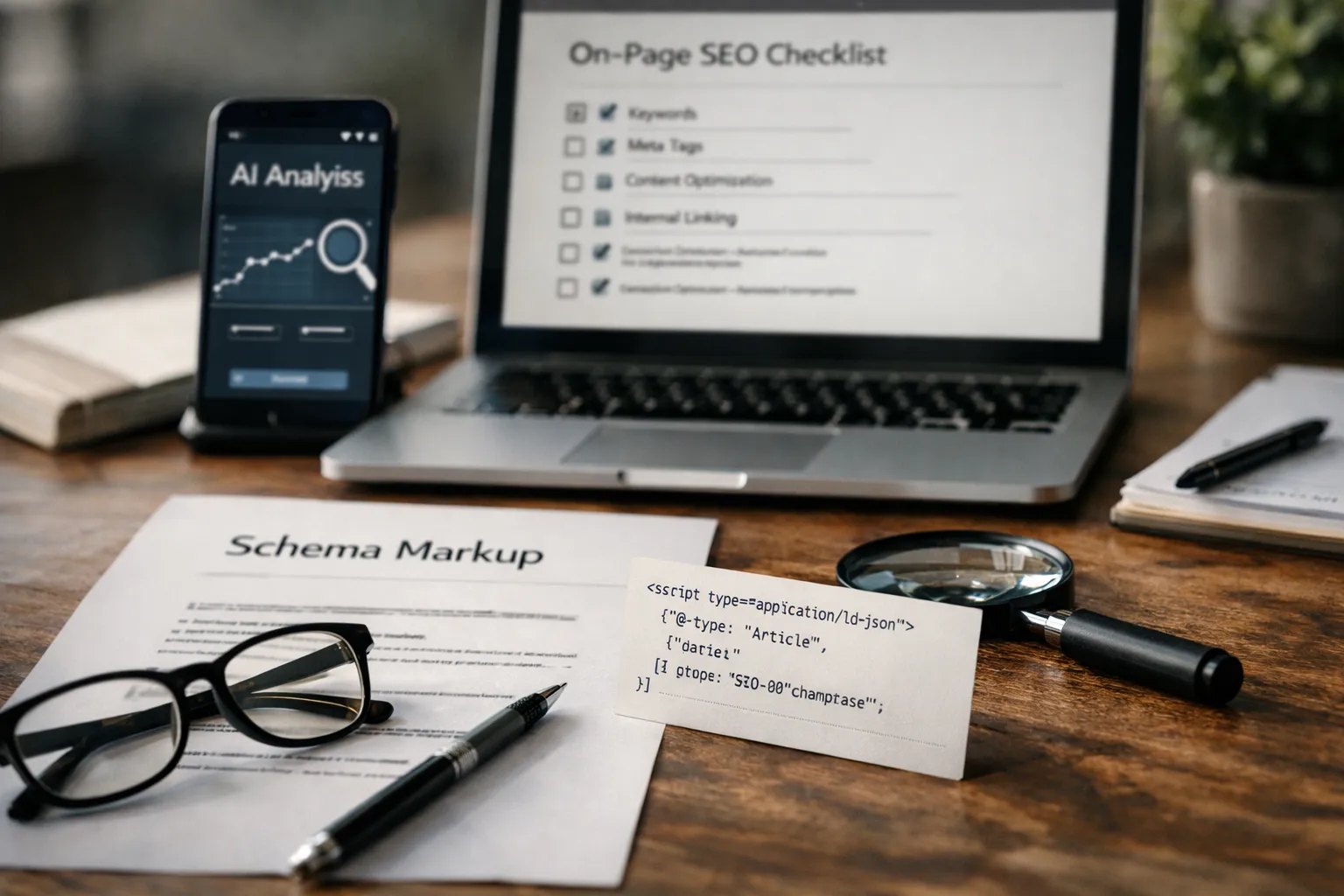
Workflow 3: On-page element optimization (titles, headings, schema) with AI
Start with the basics: title tag, H2 structure, and internal link anchors. Ask AI to propose three title tag variants that reflect the page’s primary intent. Then choose the one that is most specific, not most clever.
For headings, a useful approach is “question coverage.” AI can review a draft and suggest missing sections based on common SERP patterns, but you should sanity check every suggestion against your audience. If it does not help a real reader, it does not belong.
For structured data, AI can help you avoid tedious formatting mistakes, but you still need to validate with Google’s tools. If you add FAQ schema, make sure the questions are truly answered on the page and represent real queries. When in doubt, follow Schema.org definitions and keep markup honest.
Workflow 4: Content tuning and refresh loops using AI quality signals
Refreshing content is a high leverage habit, especially for sites with a backlog. Here is a real world example from a mid sized B2B software blog: after auditing 40 posts and refreshing 12 of them over six weeks, impressions increased 31 percent and organic sign ups increased 18 percent, mostly from updating examples, rewriting intros for clearer intent, and tightening internal links. No new backlinks required, just better alignment.
AI content optimization for SEO helps you spot what to fix. You can feed it your current article and a few competing pages and ask: “Where is this piece vague? Where does it miss key steps? Which sections feel outdated based on current product UX?” Then you apply editorial judgment and update the post.
“Treat AI like an editor with infinite patience. It will point out gaps all day. Your job is to decide which gaps matter to a human reader.”
A quick metaphor: content decay is rust. Refresh loops are maintenance.
Workflows 5-6: AI-Driven Internal Linking Strategy and Topical Architecture at Scale
Internal linking and topical architecture are the unglamorous foundation that makes everything else work better. When search engines can understand how your pages relate, your best pages get stronger, and your newer pages get discovered faster.
AI driven search optimization becomes especially useful as your site grows. At 50 pages, you can “just remember” what exists. At 500 or 5,000 pages, you need a system, and having the right stack matters (see what works and what doesn’t in AI SEO tools).
In practice, you are solving two problems: where links should go, and what content you are missing.
Workflow 5: AI-driven internal linking strategy for larger sites
Start by creating a crawl and a content inventory. Many teams use Screaming Frog for crawling, then export titles, headings, status codes, and existing internal links. Feed that inventory to AI to identify clusters and propose link opportunities based on semantic similarity and funnel stage.
The human check is crucial. AI will suggest links that are topically related but contextually awkward. The best internal links feel like a helpful aside, not a forced keyword insertion.
Here is a practical rule: prioritize links that reduce user effort. If someone is reading a “how to” guide, link to templates, examples, and next steps. If someone is reading a product comparison, link to pricing, case studies, and implementation.
Workflow 6: Entity and topical gap analysis to strengthen content architecture
This workflow asks a different question: what should exist that does not exist yet? Using AI for search engine optimization, you can extract entities from your top performing pages, map them to your product categories, and identify holes.
For example, a fintech blog might cover “business credit cards” broadly, but miss entities like “cash flow forecasting,” “expense categorization,” or “receipt capture.” Those gaps can become supporting content that builds topical depth.
When you want a more traditional validation step, compare your entity map to competitor coverage using your SEO platform. The AI gives you hypotheses. The data tells you what is worth building.
Workflow 7 and Sustainable Operations: CTR/Snippet Testing + AI-Assisted SEO Best Practices
SEO automation with AI gets risky when it becomes autopilot. Sustainable operations look more like a kitchen than a factory: prep work is standardized, but the chef still tastes the food.
In this section, you will see how to run CTR and snippet tests, then how to operationalize AI use without turning your site into a bland copy of the SERP.

Workflow 7: CTR and rich snippet testing with AI (titles, descriptions, FAQ, schema)
CTR is where rankings turn into visits. Small snippet improvements can create meaningful lifts, especially on pages that already have impressions.
A simple workflow:
- Pull a list of pages with high impressions and below average CTR from Search Console.
- Ask AI to generate title and description variants that match intent and promise a clear outcome.
- Choose one variant, update it, and annotate the date.
- Re check after 14 to 28 days, accounting for seasonality.
A concrete example: an ecommerce category page sitting in positions 4 to 6 improved CTR from 2.9 percent to 3.8 percent over four weeks after changing the title to include the primary use case and adding a value cue in the meta description. Rankings stayed roughly the same, but clicks increased about 31 percent. That is the quiet power of better snippets.
When rich results apply, use AI to draft compliant schema, then validate it and keep it aligned with visible content. Snippet gains are earned through clarity.
Conclusion and next steps: Operationalizing AI for SEO safely and sustainably
To make these workflows stick, treat them like operations, not experiments that fade after a week. Create templates for prompts, define quality checks, and decide who signs off on changes.
If you are building a light governance layer, the Google Search Quality Rater Guidelines are a helpful lens for what “quality” looks like in practice, even though raters do not directly set rankings.
The best next step is to pick one workflow and run it end to end for a month. Measure before and after, keep notes, and iterate. Momentum beats intensity.
FAQ for AI for SEO
Will using AI-generated content hurt my rankings or get my site penalized?
AI generated content is not automatically bad, and it is not automatically good. What matters is whether the page is helpful, accurate, and aligned with the query intent. If AI output leads to thin, repetitive, or misleading pages, performance tends to suffer because users bounce and competitors provide better answers.
A safer approach is to use generative AI for SEO to assist with outlining, clarity edits, and coverage checks, then add real expertise: examples from your work, screenshots, original explanations, and the nuances only a human operator would notice. Think of AI as a draft partner and a reviewer, not the author of record.
What KPIs should I track to prove that AI-assisted SEO is improving performance?
Track KPIs that match the workflow you are improving. For keyword and content work, impressions, clicks, average position, and non branded traffic are the baseline. For on page and snippet testing, CTR by query and by page is often the most sensitive signal.
If you want proof it affects the business, connect organic landing pages to conversions, assisted conversions, qualified leads, or revenue. Also watch operational metrics: time to publish, refresh cadence, and the number of pages you can keep up to date. Faster is only a win if quality stays high, especially as AI search results evolve (see how to earn citations, not just clicks).