
If you’ve ever looked at your editorial calendar and thought, “We need to publish more-but I refuse to ship fluff,” you’re already solving the right problem.
Because the hard part isn’t generating words. It’s turning messy, half-formed ideas into something you’d proudly put your name on-again and again-even when the team is slammed, launches are happening, and Slack won’t stop.
That’s where an AI content workflow earns its keep. Not by replacing people, but by forcing decisions you can’t dodge forever: What counts as a credible claim? Who signs off? Where do sources live? And what does “done” actually mean in this company?
Most teams stall in the same spots. Research gets squeezed. Drafts sound smooth but don’t land anywhere. Final edits turn into debates about tone, or worse, a last-minute fact scramble. And in regulated or high-trust categories, one careless paragraph can undo months of goodwill.
So let’s make this practical. Below is a founder-led, human-guided approach you can copy. It’s built for blogs, but it scales to newsletters, landing pages, and knowledge bases. We’ll go from topic selection to outline, drafting, review, and a clean approval gate that keeps speed and credibility moving together.
A Founder-Led AI Content Workflow: From Idea to Published Article
A founder-led process sounds intense. In reality, it’s often the quickest path to consistency.
When one person owns the editorial standard, the team stops arguing about taste and starts executing against shared rules. It’s not about control. It’s about clarity.
The practical goal is simple: make your AI-powered content process predictable. Predictable inputs. Predictable steps. Predictable quality. You should be able to hand the process to a new writer and get something solid within a week, not a month.
Governance and accountability: the founder’s editorial principles
Founder-led doesn’t mean the founder writes every post. It means the founder sets the guardrails that shape every decision in the AI editorial pipeline.
Here are three principles that hold up in the real world-especially when you’re publishing on a schedule.
First, one owner per article. Not “marketing” as an abstract group. A named person owns accuracy, structure, and outcomes. If the piece needs corrections later, you know exactly who coordinates the fix (and who learns from it).
Second, one decision maker for voice. If five people can rewrite the intro, you’ll end up with something bland-the editorial equivalent of hotel art. The founder (or a delegated editor who embodies the founder’s perspective) is the tie breaker.
Third, one definition of success. Is the goal signups, demos, backlinks, brand trust, or support deflection? You can optimize for anything, but you can’t optimize for everything in a single article. A post without a purpose is just a long document.
This governance layer also makes tooling easier. Your content production workflow with AI can evolve over time, but the accountability model should stay stable even when tools change.
Defining quality: voice, depth, and credibility standards
Quality stops being subjective the moment you write it down. In a machine-assisted writing workflow, written standards are your steering wheel.
Start with voice. Capture three to five traits that describe how your brand sounds, plus a few “never do” examples. For instance: “confident but not smug,” “plain English,” and “no hype claims without numbers.” Then give the model a short style sample from a founder email or a best-performing post-one. Not five. Consistency beats volume here.
Next, define depth. One reliable standard: “The reader should leave with at least one decision they can make today.” That pushes you toward specifics-steps, tradeoffs, examples-and away from the generative habit of saying many true things while helping no one.
Finally, define credibility. Require primary sources where possible, and label what is opinion versus evidence. If you publish in YMYL categories, add a rule that any medical, legal, or financial claim must be reviewed by a qualified human. Ask yourself: if this paragraph is wrong, what’s the blast radius?
For a deeper comparison of what AI should handle versus what needs human ownership, see our guide on AI vs human content workflows.
For teams that want a deeper framework, the NIST AI Risk Management Framework is surprisingly practical for thinking about risk, accountability, and documentation.
Phase 1 - Research and Topic Selection: AI Content Research and Outline Steps for Blogs
This phase is where most speed gains either become real or become dangerous.
Rush the inputs, and the rest of your generative AI content pipeline will look polished while quietly drifting away from reality. You’ve probably seen this in the wild: a clean draft with confident language… and a couple of claims that collapse the minute someone asks, “Wait, where’d we get that?”
Think of research like loading the pantry before you start cooking. Great ingredients make everything easier. Questionable ingredients get “covered” with seasoning-until someone takes a bite.
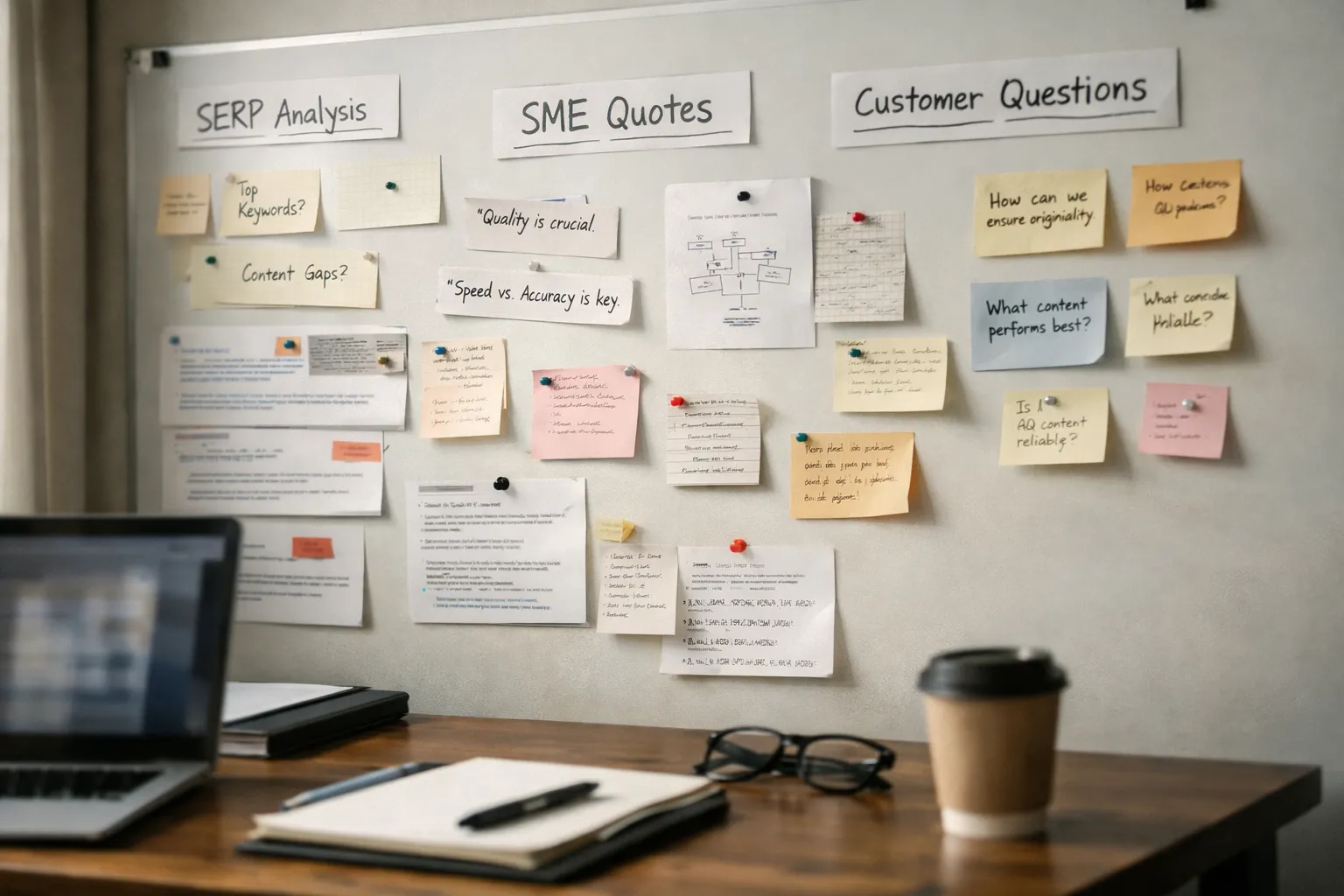
Data sources and signals we trust (SERPs, SMEs, customers)
When we do AI content research and outline steps, we treat the model like a fast analyst, not an all-knowing librarian. It can summarize patterns. It can spot gaps. But it can’t be your source of truth.
The signals that tend to hold up best:
SERPs: You’re not copying competitors; you’re mapping reader intent. What definitions show up? What subtopics keep repeating across top results? Where do the best pages disagree?
SMEs: A 15-minute interview often produces two or three insights you won’t find on page one of Google. Even better, SMEs give you constraints: what is true in your product, your market, and your customers. One good constraint can save you from writing 1,500 words that were never applicable.
Customers: Support tickets, sales calls, onboarding friction, and churn notes reveal the language people actually use. That language becomes your headings, examples, and objections. (If your draft doesn’t sound like the way customers talk, it’s harder to trust and harder to convert.)
A cautionary real-world moment: in 2023, reports described how CNET had to correct dozens of AI-assisted finance articles after publishing. The lesson isn’t “never use AI.” It’s “research and verification must be part of the system, not an afterthought.”
Here is a simple way to structure what you collect.
| Signal source | What you extract | How AI helps without taking over |
|---|---|---|
| SERPs and competitor pages | Intent patterns, missing angles, common definitions | Cluster topics and summarize recurring sections |
| SME interview notes | Non obvious claims, constraints, real examples | Turn raw notes into outline candidates and quotes to verify |
| Customer language | Pain points, objections, desired outcomes | Draft alternative headlines and intro hooks using their phrasing |
| Your product docs | Accurate feature descriptions, limits, setup steps | Convert docs into a "facts only" reference snippet for drafting |
Prompt scaffolds and research briefs that keep AI on track
A research brief is your map. Without it, the model will happily wander-and it’ll wander in full sentences that feel plausible.
In an AI content lifecycle, your brief should include:
A single-sentence problem statement, written in the reader’s words. If you can’t write this, you’re not ready to draft.
A claim inventory: what you believe is true, what you are unsure about, and what must be checked. This also prevents the common “everything is equally important” draft.
Source rules: which sources are allowed, how to cite them, and what counts as unacceptable (for example, “no statistics without a link to the original study”). Google’s own perspective is useful here, especially Google Search Central’s guidance on AI-generated content, which emphasizes helpfulness over the method of creation.
A good scaffold prompt is less “write me an outline” and more “using only the attached notes and URLs, propose three outline options, each with a distinct angle, then list what is missing.” In other words, you’re hiring the model as a gap detector.
If you use SEO tools to speed up intent analysis, link them to the brief rather than letting them dictate the article. For example, you can pull keyword clusters from Ahrefs and treat them as hypotheses to validate with SERPs and customer language. Would you let a spreadsheet pick your company’s positioning? Same idea.
Phase 2 - Outline and Draft Generation: A Human-in-the-Loop AI Writing Process
Drafting feels like the part AI should dominate. But the outline is the real lever.
A strong structure makes an average draft easy to fix. A weak structure makes even a great sentence irrelevant.
This is the heart of a human-in-the-loop AI writing process: humans choose the argument, AI accelerates execution.
Outline blueprint for blog posts (H2/H3 logic and flow)
A reliable outline blueprint reads like a chain of decisions. Each section answers a question the reader is already asking.
We use a simple logic:
Start with context: what problem are we solving and who is it for.
Move to method: the steps, in order, with clear artifacts (brief, outline, draft, review notes).
Add proof: examples, numbers, or constraints that show you’ve done this in the real world.
End with next steps: what the reader should do in the next hour.
When AI proposes headings, the editor’s job is to test the flow: “If I only read the headings, do I get the full argument?” If not, the outline needs work, not the paragraphs.
One line to remember: a good outline is a promise you can keep.
Draft control levers: tone, evidence, and narrative consistency
Once the outline is approved, drafting becomes safer and faster if you set a few control levers up front.
Tone lever: provide a short style card and one reference paragraph in your voice. Don’t paste five different examples and hope for the best. Pick one, commit, and iterate.
Evidence lever: require the draft to include citation placeholders like "[SOURCE NEEDED]" when it can’t quote a verified reference. This keeps hallucinations visible instead of sneaky-and it gives your editor a clean punch list.
Consistency lever: define one narrative thread, such as “speed and trust can coexist if you add gates.” Then ask the model to check every section for alignment with that thesis. If a paragraph doesn’t support the thesis, it either gets rewritten or cut.
Here’s what this looks like in practice: we once had a draft that read beautifully-tight transitions, confident tone, even a clever metaphor. The problem? It contradicted our own product limitations in two places. No one noticed until a support lead read it and said, “If we publish this, we’ll get tickets all week.” The fix wasn’t better writing. The fix was a better “facts only” panel and stricter evidence placeholders.
"AI drafts are cheap. Editorial confidence is expensive." Treat confidence like a budget you spend carefully.
Tooling note: if you draft in Google Docs or Notion, keep a dedicated "Verified facts" panel at the top of the document. It becomes the single source of truth the model must follow when rewriting.

Phase 3 - Editorial Review, Fact-Checking, and SEO Optimization
This is where most teams either earn trust or lose it.
Editing isn’t just polishing. It’s verification, alignment, and risk management. And yes, it’s also where you protect your voice from getting smoothed into the generic “AI blog tone.”
A strong AI-driven editorial workflow doesn’t shame AI errors. It expects them-and catches them early.
On-page SEO checklist for AI-generated articles
On-page SEO isn’t a magic trick. It’s a set of small decisions that make the page easier to understand for humans and search engines.
The twist with AI-assisted content is that the draft often sounds fluent even when it’s thin. So your checklist should test substance, not just formatting. Ask yourself: if a smart reader skimmed this, would they learn something real-or just feel like they did?
| Checklist item | What to look for | Owner |
|---|---|---|
| Search intent match | Intro and headings match what the query implies | Editor |
| Original contribution | A unique example, framework, or point of view | Founder or lead writer |
| Claim verification | Each factual claim ties to a source or internal doc | Fact checker or SME |
| Internal consistency | Terms used the same way across sections | Editor |
| Readability | Short paragraphs, clear definitions, no filler | Writer |
| Metadata basics | Title and meta description reflect actual content | SEO lead |
If you want a north star for what search engines reward, anchor on "helpful" and "people first" content. Google’s documentation on creating helpful content is worth revisiting whenever you update your standards.
After the first edit pass, do a dedicated fact-check pass. Separate the mindsets. Editing is about clarity. Fact-checking is about truth. Mixing them sounds efficient, but it usually makes you miss things.
Approval gate: SMEs, legal, and brand sign-off
Approval gates aren’t bureaucracy when they’re lightweight and predictable. They’re how you scale trust without slowing to a crawl.
A practical gate sequence looks like this: editor approves structure and clarity, SME approves technical truth, then brand or legal approves claims and compliance where relevant.
If you work with endorsements, testimonials, or reviews, align language with the FTC’s endorsements guidance. It can influence how you describe outcomes, especially when a draft starts to sound a little too confident.
This is also where you define what needs extra caution. If a post mentions pricing, security, medical guidance, or legal interpretations, require a domain reviewer. If it’s a simple how-to, the editor may be enough.
Use a tight checklist to keep approvals from becoming subjective:
- Every statistic has a traceable source and a date.
- Every product claim matches current documentation.
- Every example is either real and attributable, or clearly hypothetical.
- The intro promises what the body delivers.
- The conclusion includes one clear next action.
- Disclosures are present when needed.
- The final draft passes a plagiarism scan and a basic grammar pass.
FAQ for an AI Content Workflow
Most questions about an AI-assisted content creation system are really questions about control. Who decides what gets published? How do you stop errors? How do you keep the content from sounding like everyone else?
These answers are the ones that matter in day-to-day operations.
How is a founder-led AI content strategy different from a typical content team?
A typical content team distributes ownership. That can work, but it often creates drift: different writers interpret "quality" differently, and the backlog becomes a patchwork.
A founder-led approach centralizes the editorial principles, even if execution is distributed. Writers still write. Editors still edit. But the founder (or a single delegated editorial lead) defines the non-negotiables: voice, positioning, what claims are allowed, and what risks are unacceptable.
In practice, this reduces revision loops. Instead of debating taste, you evaluate against a written standard.
What tools are essential for an AI content workflow for blogs?
You need fewer tools than people think. What you actually need is a clean place to store briefs and sources (a doc system like Notion or a shared drive), a drafting environment (Docs is fine), an SEO research tool (optional but helpful, like Semrush or Ahrefs), and a model interface or API for drafting and rewrites.
The make-or-break piece isn’t software, though-it’s the fact-checking habit. If you add more tools, do it because they remove a specific bottleneck, not because they look impressive on a stack diagram.
How do you prevent AI hallucinations during research and drafting?
You don’t prevent them by asking nicely. You prevent them by changing the environment.
First, constrain inputs. Provide notes, links, and internal facts, and instruct the model to use only those.
Second, force uncertainty to be visible. Require "[SOURCE NEEDED]" tags instead of made-up citations. If the model can’t support it, it has to admit it.
Third, separate passes. Research pass produces a source list and claims. Draft pass uses only approved claims. Edit pass checks clarity. Fact-check pass verifies truth.
Finally, keep a correction log. When an error slips through, record what failed: the brief, the prompt, the review, or the approval gate. Then update the system. That’s how your process gets smarter over time.
What belongs in an SEO checklist for AI-generated articles?
Include items that protect substance and structure.
Intent match, original contribution, claim verification, and internal consistency come first. Then the basics: clear headings, descriptive title tag, scannable formatting, relevant internal links where appropriate, and a meta description that reflects the content.
If your checklist is only about keywords, it will miss the real risk: fluent nonsense. If you’re seeing that risk show up in rankings, this breakdown of why most AI content fails SEO will help you spot the failure modes faster.
Where should humans intervene in a human-in-the-loop AI writing process?
Humans should intervene at every decision point, not every sentence.
Humans choose topics based on business priorities and audience pain. Humans approve the outline because it defines the argument. Humans verify facts, especially in technical or regulated areas. Humans also own voice. AI can mimic style, but only you can decide what your brand believes.
A useful rule: if the decision could harm trust, a human owns it. When you’re unsure, ask a simple question: “If this is wrong, who pays the price?”
How do you measure quality and consistency across AI-written posts?
Use a mix of leading and lagging indicators.
Leading indicators include: time to first draft, number of revision cycles, percentage of claims with sources, and how often SMEs request changes.
Lagging indicators include: organic engagement, conversion rate from the post, support deflection, and qualitative feedback from sales or customer success.
One practical approach is a monthly editorial scorecard. Pick five criteria, score each post 1 to 5, and review trends. Over time, you’ll see whether your AI content operations are getting sharper or just faster.
Conclusion and Next Steps: Make Your AI Content Workflow Both Fast and Trustworthy
Speed is easy to buy. Trust is slow to earn. The best teams build a content process map that protects both.
If you want to implement this quickly, start small. Pick one topic, write one research brief, run one draft, and apply one review gate with real fact-checking. Don’t try to automate the whole system on day one-that’s how teams end up with a lot of output and very little confidence.
Then document what worked. Save the brief template, the outline blueprint, and the checklist. Those artifacts are the compounding asset in your AI article production process.
Once the system is stable, scale volume. Add writers, add topics, add distribution. But keep the same rules. If you want a more tactical, step-by-step version geared to organic search, use this 2025 guide on AI content writing for SEO.
Because the real win isn’t that AI can write. The win is that your team can publish with confidence, week after week, without losing the voice and credibility that made people care in the first place.