Nearly half of Google searches carry local intent, and "near me" queries have exploded on mobile in the past few years, according to Think with Google. Translation? Visibility isn’t just about what you offer-it’s about where people are and which language they use when they’re ready to act. If your pages don’t map to real-world geography and language preferences, you’re quietly leaking revenue, no matter how strong your content is.
This is where geo targeting SEO enters the chat. Done well, it helps you meet searchers where they are-by country, region, and city-and doubles down with the right language, currency, and cultural cues. You don’t need a brand-new site for every market. You do need a plan that braids together technical foundations, localized content, and trustworthy city/country signals that Google (and humans) recognize instantly.
In this guide, you’ll learn the nuts and bolts of GEO SEO, how location-focused keyword research shifts between Germany and the USA, and how hreflang keeps duplicates in check while unlocking multilingual rankings. We’ll also walk through scalable templates for local landing pages and an AI-driven workflow that turns research into revenue-without sacrificing quality. Think of it as your roadmap to showing up in the right place, in the right language, at the exact moment someone needs you. Ready?
What is GEO SEO? A clear definition of geo targeting SEO and how local + multilingual optimization drive global visibility
GEO SEO is the practice of aligning your site’s content, structure, and signals with the way people actually search by geography and language. It blends country-level, regional, and city-level targeting with multilingual and multiregional tactics so search engines can route the right page version to the right user. When teams talk about geo targeting SEO, they usually mean a coordinated strategy spanning technical implementation, on-page localization, and market-specific link and brand signals.
Think of it like a smart switchboard. Someone in Zurich on a German-language device shouldn’t land on your generic English homepage. They should see the Swiss-German page with CHF pricing, local proof, and copy that sounds like it was written for them-not translated for them. That’s GEO SEO doing its job.
GEO SEO explained: geo targeting SEO vs local, international, and multilingual SEO
Local SEO focuses on city or neighborhood visibility and often includes Google Business Profiles, NAP consistency, and local citations. International SEO aims to serve multiple countries, sometimes with the same language (US vs UK English) or different languages (Germany vs USA). Multilingual SEO ensures each language lives in its own crawlable, indexable space and that users are directed to the best language version. GEO SEO is the umbrella that orchestrates all of this, making sure search engines and users get the right content variant based on locale and language.
Why does this distinction matter in the real world? Because operations follow strategy. Local SEO without multilingual nuance might rank in Berlin but fall flat on German-language expectations. Multilingual SEO without city-level proof can rank nationally yet miss the conversion-rich intent of someone searching in a specific neighborhood. GEO SEO balances both: zoomed-out country relevance and zoomed-in city proof. Ask yourself: if a customer called you from Munich right now, would your page answer their exact needs-or a generic version of them?
Geo targeting SEO strategy for multi-country websites: pillars and outcomes
Start with market discovery: size the opportunity, map competitors, and note SERP differences by country and city. Then choose a scalable site architecture (ccTLD, subdomain, or subfolder), add hreflang, and make sure canonicals prevent duplication. Next, localize on-page elements: units, currency, imagery, examples, testimonials, FAQs-even legal and tax nuances. Measure speed and Core Web Vitals from your target countries; smart CDN placement can quietly lift rankings and conversions. Finally, reinforce each locale with regionally relevant links and PR so authority grows where it matters.
What should you expect? Clearer intent matching (higher CTR), fewer bounces from mismatched expectations, and stronger conversions from localized proof. Teams often track a rising share of non-brand traffic by country, more top-3 rankings for city terms, and less cannibalization between language variants. One client of ours saw UK traffic surge after we swapped USD for GBP and added British case studies-same product, better context, 22% more demos.
Geo-targeted keyword research for Germany vs USA: intent gaps, SERP features, and seasonal nuances
Even within the same vertical, Germany and the USA can produce wildly different SERPs. Germany often favors informational pages that speak to compliance or formal language. The USA leans commercial: comparison lists, how-to videos, and strong calls to action. Seasonality diverges too. German holidays, public closures, and long summer breaks can shift demand curves compared with US shopping sprints and holiday spikes.
These nuances matter. Build for the wrong moment and you’ll publish beautiful pages that arrive late to the party. Build for the right moment and you’ll look like you read the customer’s mind.
City and country level SERP optimization techniques: when to target Berlin vs Germany vs DACH
For Germany, many categories show city-first intent: "Dienstleistung + Stadt" signals a local need. If your offer is service-based-photography, home services, clinics-city pages backed by NAP, LocalBusiness schema, and locally sourced reviews usually beat generic country pages. For software that serves nationally, a country-level hub can anchor authority, while city pages capture high-intent, lower-volume terms like "Software X Beratung Berlin."
For DACH (Germany, Austria, Switzerland), expect spelling and vocabulary differences and shared German across countries. A pragmatic approach: build a German-language hub for each country (DE, AT, CH), then add city pages where volume and competition justify the lift. Not sure where to start? Test one polished city page per country, measure lead quality and conversion rate, and scale what works. Small pilots de-risk big bets.
Mini-case: “AI Headshots Germany” vs “AI Headshots USA” - volumes, modifiers, and conversion patterns
A studio we advised spotted telling differences between Germany and the USA. Germany skewed toward explicit modifiers like "Datenschutz" and "Preis," while the USA favored "best," "near me," and speed-related queries. That insight reshaped the landing pages and the offer positioning.
| Query Variant | Est. Monthly Volume (DE) | Est. Monthly Volume (US) | Notable Modifiers | Conversion Signal |
|---|---|---|---|---|
| ai headshots | 2,100 | 9,500 | "Preis" (DE), "cost" (US) | Price calculators lift CVR |
| ai headshots berlin | 350 | - | Neighborhood names (DE) | NAP + local reviews matter |
| ai business headshots | 500 | 2,700 | "professional", "studio" | Trust badges boost CTR |
| corporate headshots ai | 200 | 1,600 | "best", "near me" (US) | Local packs drive clicks |
After launching localized pricing tables and adding German-language FAQs referencing data privacy, DE conversions rose 28% with similar traffic. In the US, city-specific trust signals and faster delivery messaging boosted trial sign-ups by 41%. Same product. Different levers. Big outcomes.
Multilingual geo SEO with hreflang tags: architecture, canonicalization, and duplication control
Multilingual and multiregional setups live or die by clarity. Search engines must know which URL serves which language and country-and how near-duplicates are handled. Hreflang is your routing system, but it only works if your architecture is clean and your canonicals don’t contradict it. Get this wrong and you’ll ship great pages that never find their audience.
Hreflang implementation patterns and pitfalls (ccTLD vs subdomain vs subfolder)
There’s no single “best” pattern, only trade-offs. ccTLDs (example.de) send strong country signals and can build trust in some markets, but they fragment authority and increase overhead. Subdomains (de.example.com) provide separation with moderate complexity. Subfolders (example.com/de/) consolidate link equity and are easier to manage at scale.
No matter what you choose, keep hreflang reciprocal: every locale version must reference the others, and x-default should catch ambiguous users. Don’t point hreflang at non-indexable URLs or pages with conflicting canonicals. Validate in Search Console and sample your logs. The Google Search Central guide is the source of truth-bookmark it and use it.
Clear architecture beats clever hacks. If hreflang, canonicals, and sitemaps tell the same story, crawlers listen.
Site architecture, canonicals, and parameter handling for international crawling
Give each locale a dedicated, crawlable path with consistent URL patterns. Canonicals should point to themselves within each locale; don’t canonicalize DE to EN just because the content feels similar. Use hreflang to express equivalence across locales, not canonicals. For parameters (currency, units, filters), avoid indexable parameter permutations. Render sensible defaults server-side per locale and apply noindex to non-canonical parameter states.
Speed matters by geography. Host media on a CDN with edge nodes near priority markets. Test performance from Frankfurt, London, New York, and Singapore-you’ll see real differences. Align sitemaps per locale; large sites often ship one sitemap index that links to a sitemap per language-country pair. Clean maps help crawlers spend their time where you want.
Local landing pages for international search visibility: structure, signals, and scale without thin content
Local landing pages shouldn’t be lazy templates with the city name swapped in. They’re mini homepages for each market-packed with unique proof: customer stories, photos, pricing or terms that reflect local reality, and internal links that make sense from that city’s point of view. Standardize the skeleton, but keep the soul local.
Here’s a quick story. A home services brand launched 20 lookalike city pages and saw crickets. We rebuilt the top five with real local photos, quotes from neighborhood clients, and city-specific FAQs about parking and timing. Those five pages drove 80% of leads within a month. Same layout, real proof.
On-page signals that move the needle: NAP, local schema, E-E-A-T cues, and internal links
Start with NAP (name, address, phone) consistency across your site, Google Business Profile, and top directories. Add LocalBusiness schema and city-specific FAQs. We’ve seen German pages lift conversions simply by mentioning tax details and references to local privacy standards. Internal links should connect a city page to nearby service areas and relevant case studies-not just a generic blog.
- Publish a verifiable address or service radius, then reinforce with LocalBusiness schema.
- Include localized testimonials with full names and, when possible, links to client websites.
- Add city-specific FAQs that answer parking, delivery times, or holiday schedules.
- Link to nearby areas and a localized contact or booking flow.
- Feature market-relevant credentials (e.g., ISO certifications, insurance details) for trust.
Ask yourself: if a skeptical local landed here, would they feel you’re actually in their city-or only pretending to be?
Reusable content templates for city pages: UX, trust elements, and avoiding duplication
Design a reliable pattern: a hero with a localized headline and subhead, an intro paragraph that references the city’s context, service modules, a portfolio or gallery with local tags, social proof, FAQs, and a clear CTA. Rotate proof elements to maintain uniqueness: different case studies, images actually shot in that city, and regional partnerships that matter locally. For Germany, add an “Impressum” and privacy notes; for the USA, highlight delivery speed and price transparency.
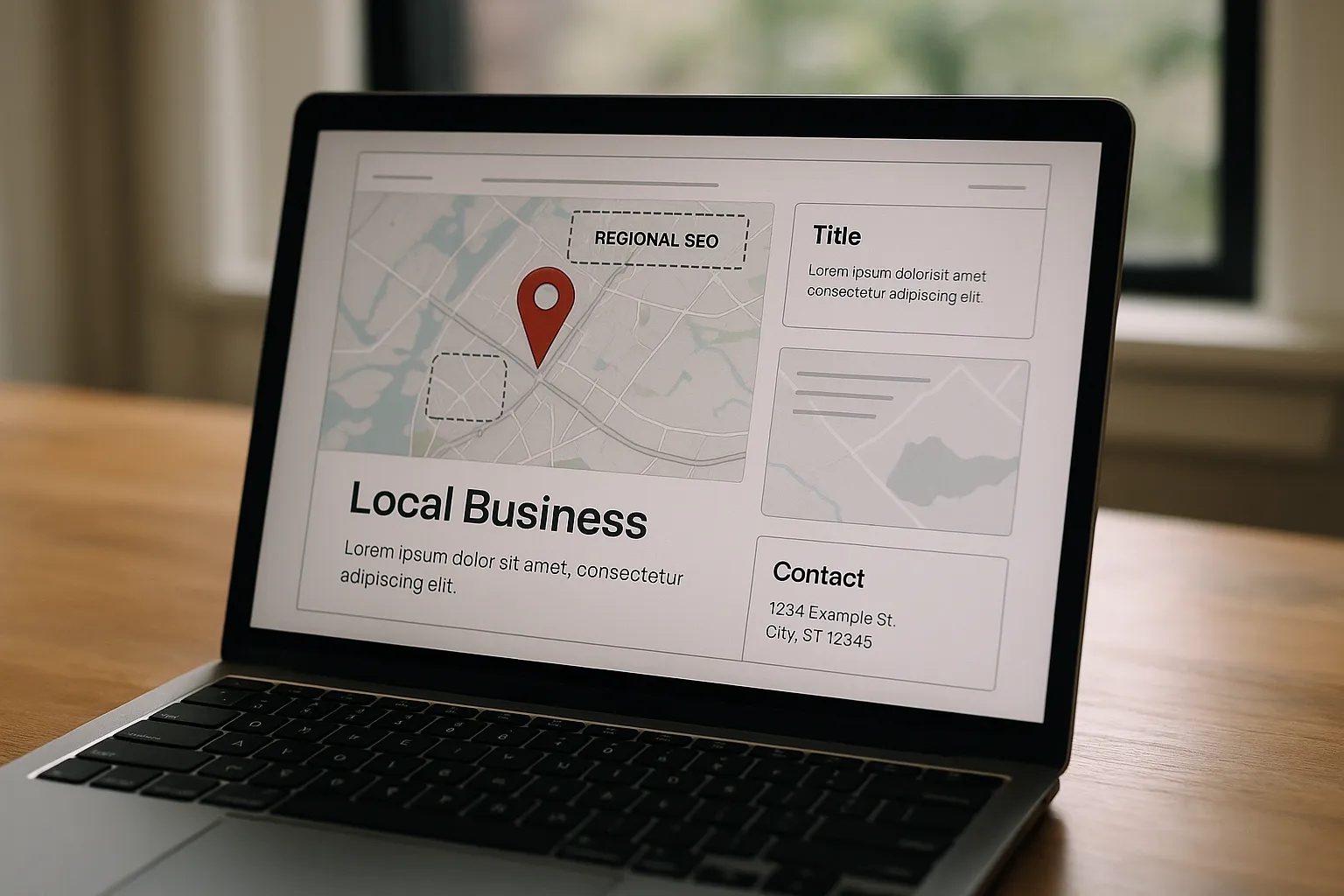
Thin content happens when every city page reads the same. If you can’t produce unique proof for a city, don’t launch that page yet. One stellar page beats ten hollow ones. Quality convinces; duplication deflates.
AI-driven content localization for SEO at scale: from research to on-page to link earning
AI can accelerate research, briefs, and first-draft localization-if you wrap it with strong guardrails. You still need expert QA, market-specific legal checks, and real-world proof elements. Think of AI as an exoskeleton for your team, not an autopilot. It makes you stronger, not hands-free.
Workflow: AI-assisted keyword mapping, brief generation, and localized page creation & QA
Start with market segmentation and keyword clustering per country and city. Tools like Ahrefs or Semrush validate volumes and difficulty. Use AI to draft briefs that “know” local modifiers (e.g., Preis vs cost), then generate outlines and first drafts. Translate with DeepL or write natively; either way, editorial QA must catch idioms, compliance notes, and tone.
| Step | Purpose | Suggested Tooling |
|---|---|---|
| Locale keyword clustering | Map demand by country/city | Ahrefs/Semrush, spreadsheets |
| SERP feature audit | Identify packs, videos, pricing | Manual checks, plugins |
| Brief + outline | Encode local modifiers & proof | LLM prompts, templates |
| Draft + translate | Create first-pass pages | DeepL, LLMs |
| Expert QA | Correct nuance & compliance | Human editors, style guides |
| Publish + monitor | Track by locale & city | GSC geo filters, rank trackers |
Don’t stop at copy. Local imagery, testimonials, and partners move the needle. In one DE/AT/CH rollout, a SaaS added localized screenshots, currency pricing, and German-language onboarding. Sign-ups rose 34% in DE and 19% in CH, while support tickets dropped thanks to clearer expectations.
Guardrails: cultural nuance, compliance (GDPR/CCPA), tone, and brand voice alignment
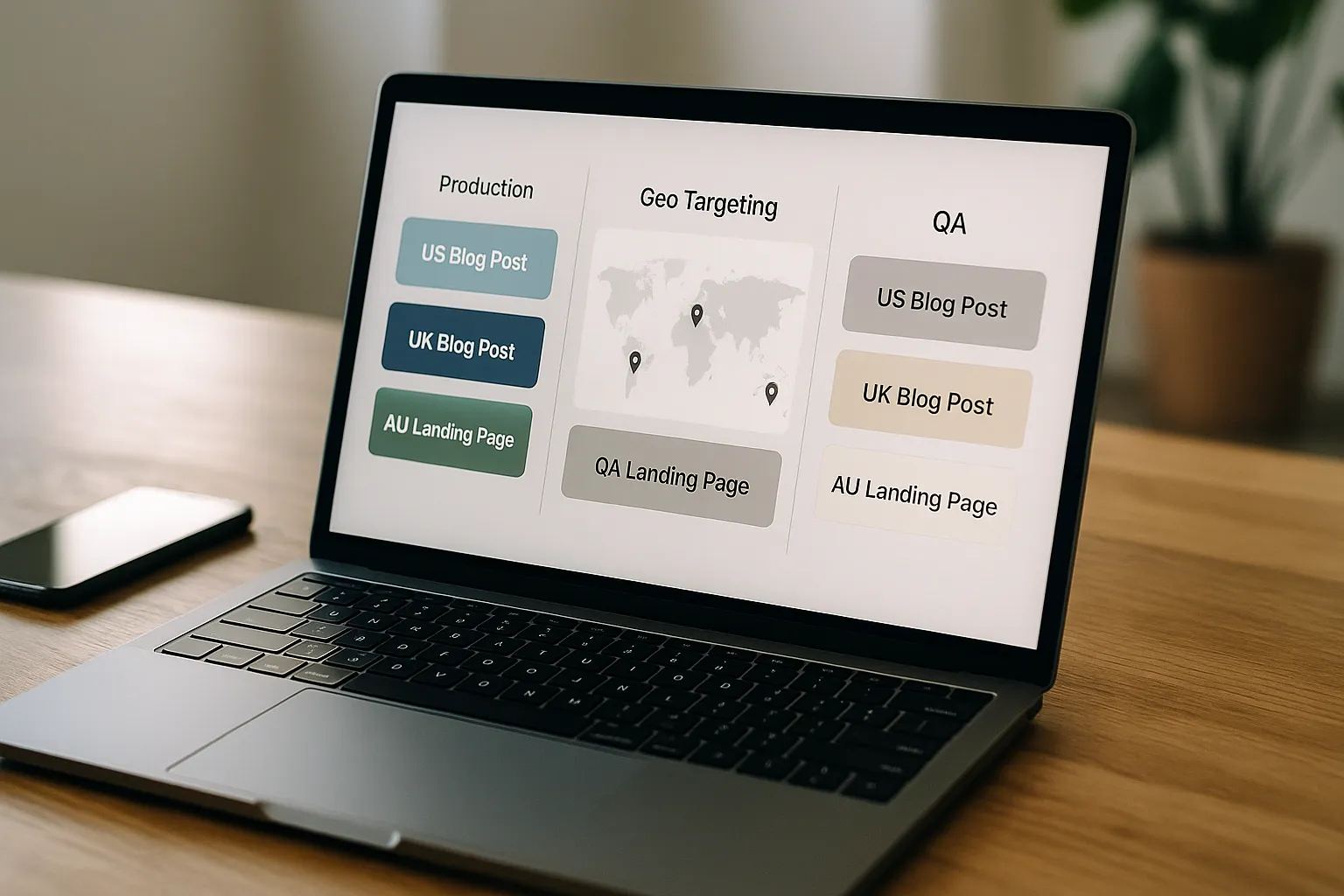
Cultural nuance isn’t optional. German audiences often prefer a more formal tone and detailed pricing; US audiences reward speed and brevity. Compliance can’t be an afterthought: GDPR (EU) and CCPA (California) affect forms, tracking, and cookie disclosures. Bake these into templates and QA checklists from day one. Finally, protect brand voice with locale-specific style guides. If your English site is punchy, your German site can be respectful without sounding robotic. Same brand, different melody.
FAQ for geo targeting SEO
Before we wrap, here are quick answers to common questions teams ask when they begin expanding across borders and cities.
FAQs: GEO SEO vs local SEO, hreflang basics, ccTLD vs subfolder, and how AI localizes content automatically
- What’s the difference between GEO SEO and local SEO? GEO SEO spans countries, languages, and cities; local SEO focuses primarily on city-level signals and Google Business Profiles.
- Do I need hreflang if the content is in the same language (US vs UK)? Yes. Use hreflang for regional variants to reduce cannibalization and serve the right regional page.
- Should I choose ccTLD, subdomain, or subfolder? Subfolders often win for speed and equity consolidation; ccTLDs can help trust in some markets but raise maintenance overhead.
- Can AI localize content end-to-end? It can accelerate drafts, but human QA is essential for accuracy, compliance, and cultural fit. Tools like Weglot can assist operationally.
Conclusion and next steps: assemble your GEO SEO stack and launch in priority markets
Define a short list of priority markets and city targets based on demand and readiness. Choose your architecture, implement hreflang, and ship one high-quality localized page per market before scaling. Instrument tracking by country and city; watch for shifts in CTR, bounce, and conversion. Pair research tooling with a localization workflow and clear QA gates. If you stay focused on intent, language, and proof, geo targeting SEO stops feeling like a maze and starts acting like a map.
Assemble your stack, roll out in waves, and iterate. Locale by locale, you’ll get faster, sharper, and more relevant-exactly what users (and search engines) reward.